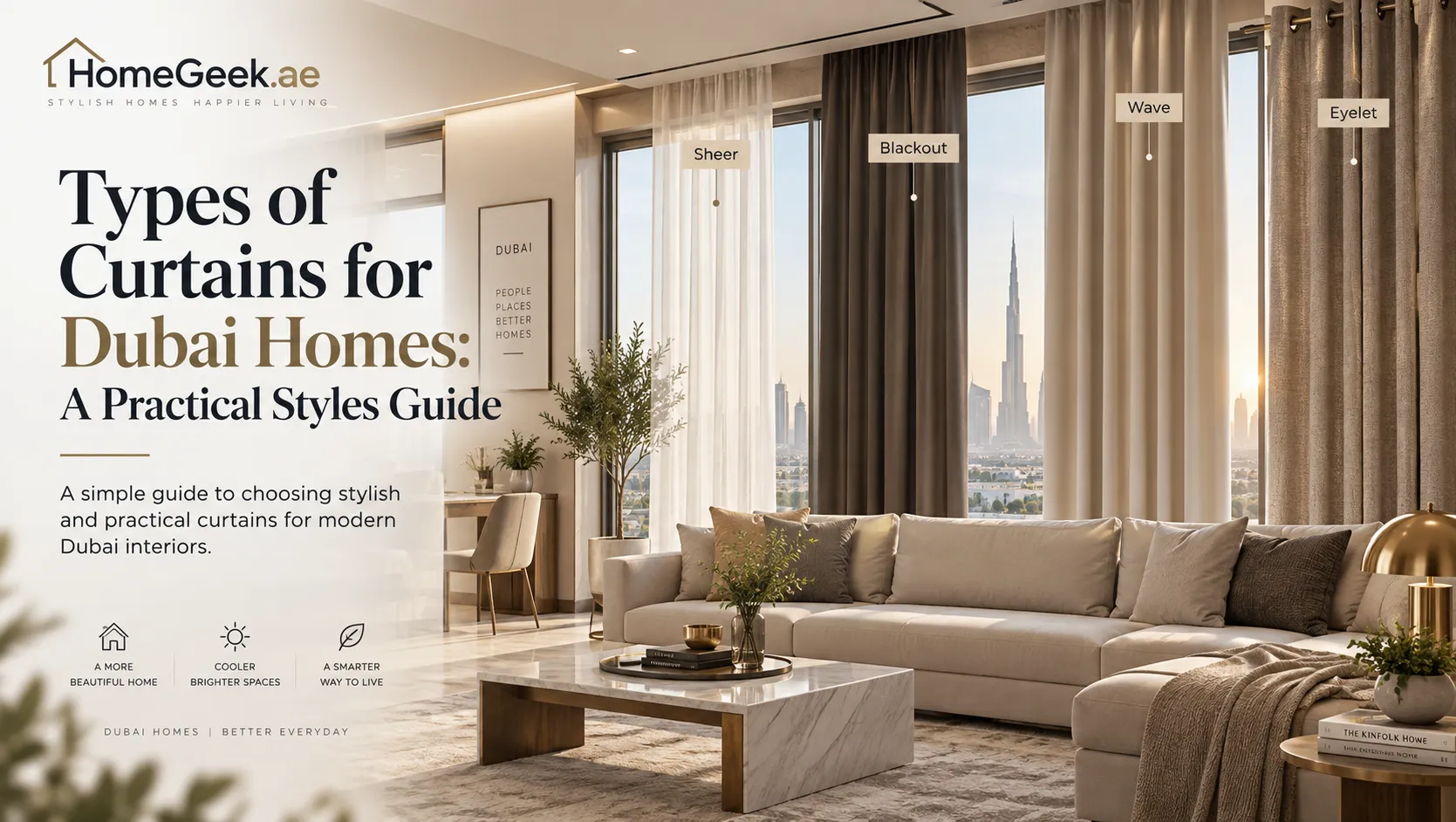
Types of Curtains for Dubai Homes: A Practical Styles Guide
The best curtain type for a Dubai home depends on four separate choices: how much light you want to control, the heading style you prefer, the fabric and lining, and whether the curtain is manual or motorized. For many UAE homes, a layered setup with sheer curtains for daytime and lined or blackout curtains for privacy and stronger light control is the most flexible option.
Dubai homes often have large glazed areas, strong sunlight, air-conditioned interiors and a mix of modern apartments and high-ceiling villas. That means curtains need to do more than look good. They must manage glare, privacy, heat exposure, window height and daily convenience. This guide separates curtain “types” properly so you can compare like with like and choose a setup that suits the room.
| Quick Summary |
| • Sheer, dimout and blackout describe how a curtain controls light; they are not heading styles. |
| • Wave, eyelet, pinch pleat and pencil pleat describe how the curtain is formed and attached at the top. |
| • Layered sheer + lined curtains are one of the most practical choices for Dubai living rooms and bedrooms. |
| • Wave curtains suit clean, full-height contemporary interiors; pinch pleats suit more formal rooms. |
| • Motorized tracks make the most sense for wide, tall or hard-to-reach windows rather than every window in the home. |
What Are the Main Types of Curtains?
Curtain “type” can describe function, construction, heading style or operation. This is where many buying guides become confusing. A blackout curtain can also be a wave curtain; a sheer curtain can also use a pinch-pleat heading; and either one can run on a manual or motorized track.
A cleaner way to compare curtains is to split the decision into four layers:
- Light-control type: sheer, dimout, blackout or layered.
- Heading style: wave/ripple fold, eyelet, pinch pleat or pencil pleat.
- Fabric and lining: polyester blends, linen-look weaves, velvet, jacquard, thermal or blackout lining.
- Operating system: manual track, curtain rod or motorized track.
Homegeek insight: Choose the function first, then the style. A beautiful heading cannot solve a bedroom that is too bright, and a blackout lining will not fix a curtain that stacks badly beside a narrow window.
Curtain Types by Light Control and Privacy
For Dubai homes, light control is usually the most important starting point because it affects comfort, glare, privacy and how the room feels throughout the day.
1. Sheer Curtains
Sheer curtains use lightweight, semi-transparent fabric to soften daylight instead of blocking it. They are ideal for living rooms, dining spaces and bright apartments where you want daylight without leaving the glazing completely exposed.
Sheers work especially well on floor-to-ceiling windows because they reduce visual harshness while preserving an open feel. The limitation is night-time privacy: once interior lights are on, a sheer layer alone may not provide enough screening. This is why Dubai homes often pair sheers with a second, heavier curtain.
2. Blackout Curtains
Blackout curtains are designed for strong light blocking and privacy. They are best suited to bedrooms, nurseries, home cinemas and rooms with direct morning or afternoon sun. Performance depends on both the fabric and the installation. Light can still enter around the sides, top or centre if the track coverage is poor.
For bedrooms, focus on edge coverage and track positioning rather than assuming any fabric labelled “blackout” will create hotel-level darkness. A ceiling-mounted track with sufficient overlap usually gives better control than a short rod that leaves gaps.
3. Dimout Curtains
Dimout curtains sit between sheer and full blackout. They reduce a large amount of incoming light but do not aim to create complete darkness. They can suit guest rooms, home offices and living spaces where screen glare needs to be reduced without making the room feel closed during the day.
4. Layered Curtains
Layered curtains combine two functions, usually a sheer inner layer and a lined or blackout outer layer on a double track. This is one of the most versatile arrangements for the UAE because the window can stay bright and softly private during the day, then become more private and darker at night.
Layering also gives more flexibility than choosing one heavy curtain for every situation. In a Dubai living room, for example, the sheer layer can stay closed through bright hours while the heavier drape is used only when glare, heat exposure or privacy becomes a problem.
Curtain Heading Styles: Wave, Eyelet, Pinch Pleat and Pencil Pleat
The heading determines how the curtain folds, how it stacks when open and which hardware it needs. For modern Dubai interiors, wave headings are common because they create uniform folds and work well with tracks. More traditional rooms often benefit from pinch pleats, while eyelet and pencil pleat styles are practical for simpler installations.
| Heading style | Look | Best for | Hardware | Watch-outs |
| Wave / ripple fold | Clean, even S-folds | Modern apartments, full-height glazing, motorized systems | Dedicated wave track | Needs correct track and stack space |
| Eyelet | Relaxed, rounded folds | Rental apartments, casual bedrooms/living rooms | Curtain rod | Not ideal for concealed tracks or full motorization |
| Pinch pleat | Structured and formal | Villas, majlis, dining and formal rooms | Track or decorative pole | Uses more fabric and looks more traditional |
| Pencil pleat | Classic gathered finish | Budget-conscious or existing-track installations | Most standard tracks/poles | Less architectural than wave |
Which Curtain Type Works Best in Each Dubai Room?
Room use should decide the curtain before colour or trend. A bedroom needs darkness and privacy, while a living room often needs softer daylight and a better view. The strongest specification is therefore room-specific rather than using one curtain type throughout the entire property.
| Room | Recommended setup | Why it works | Good style choice |
| Living room | Sheer + lined outer curtain | Flexible daylight, glare and privacy control | Wave for contemporary interiors |
| Master bedroom | Sheer + blackout | Daytime softness with strong night-time darkness | Wave or pinch pleat |
| Kids room | Secure track + blackout or dimout | Light control with simpler, safer hardware | Track-based wave/pencil pleat |
| Home office | Sheer or dimout | Reduces glare without making the room too dark | Wave or pencil pleat |
| Majlis / formal lounge | Lined decorative curtain, optional sheer | Adds visual weight and privacy | Pinch pleat |
| Double-height villa window | Layered, often motorized | Easier operation across tall glazing | Wave on motorized track |
What Should Dubai Homeowners Consider Before Choosing Curtains?
Dubai-specific curtain selection should consider window direction, glass area, privacy, maintenance and air-conditioning load, not just fabric colour. The U.S. Department of Energy notes that windows can account for roughly 25% to 30% of residential heating and cooling energy use, and recommends window coverings as one way to control direct solar gain. This is not a promise that curtains alone will cut an AC bill by a fixed percentage, but it shows why solar exposure matters when specifying window treatments.
Sun direction and glare
West-facing glazing can receive strong afternoon sun, while east-facing bedrooms may need stronger morning light control. Treat orientation as a practical specification issue.
Window height and width
Full-height and double-height glazing needs enough fabric stack space. A curtain that looks compact when closed can occupy a substantial width when open.
Privacy at day and night
A sheer can provide useful daytime screening, but privacy changes after dark when indoor lights are brighter than the exterior. Layering solves this more reliably.
Maintenance and dust
Dubai dust makes easy removal, washable fabrics and accessible tracks valuable. Very heavy or delicate fabrics can increase maintenance effort.
Existing ceiling details
Recessed curtain pockets, gypsum ceilings and AC vents can affect track placement. Hardware should be planned around the room, not added as an afterthought.
Manual vs Motorized Curtains in Dubai
Motorization is most valuable when it solves an access or scale problem. Wide sliding doors, tall villa windows and hard-to-reach glazing benefit more than a small standard bedroom window. Motorized tracks also suit smart-home routines where curtains open or close on a schedule, wall switch, remote or compatible automation system.
Manual curtains remain the simpler choice for most standard windows because they cost less, have fewer components and are easy to maintain. A mixed approach often makes more sense: motorize the main living area or double-height windows, then use manual tracks in secondary rooms.
How to Choose the Right Curtain Type in 5 Steps
- Decide the main function: daylight filtering, privacy, room darkening, glare control or decoration.
- Match the room: bedrooms usually need more light control than living rooms and dining spaces.
- Choose the heading: wave for a clean contemporary look, pinch pleat for formality, eyelet or pencil pleat for simpler setups.
- Check hardware and measurements: confirm track position, stack space, ceiling detail and how the curtain will clear furniture or doors.
- Then choose fabric and colour: after function and construction are fixed, select a fabric that suits the interior and maintenance requirements.
Common Curtain Buying Mistakes in Dubai
- Choosing fabric before deciding how much light or privacy the room needs.
- Treating “blackout”, “wave” and “motorized” as competing curtain types when they describe different parts of the specification.
- Using a short rod on a wide window, leaving insufficient stacking space and reducing the usable view.
- Ignoring gaps around blackout curtains and then expecting complete darkness.
- Installing motorized curtains on every window instead of prioritising large or hard-to-reach openings.
- Copying one curtain setup across the whole home even though each room has different light and privacy needs.
Frequently Asked Questions
What are the most popular types of curtains for Dubai homes?
Sheer, blackout, layered and wave-style curtains are widely used because they suit the UAE’s bright conditions and contemporary interiors. The key is to separate function from heading style: a curtain can be both blackout and wave, or sheer and wave, depending on the fabric and track.
Which curtains are best for a Dubai living room?
A layered setup with sheer curtains and a lined outer curtain is a strong all-round option for Dubai living rooms. The sheer controls bright daytime light while keeping the room open, and the outer layer provides extra privacy and glare control when needed.
Which curtains are best for bedrooms in the UAE?
Bedrooms usually benefit from blackout or heavily lined curtains, ideally with good side and top coverage. If you also want daylight during the day, use a double-track setup with a sheer inner layer and blackout outer layer.
Are wave curtains the same as blackout curtains?
No. Wave describes the heading and fold pattern, while blackout describes light-control performance. A wave curtain can use sheer, dimout or blackout fabric. This distinction is important when comparing quotes because the track, fabric and lining are separate choices.
Are motorized curtains worth it in Dubai villas?
They are most worthwhile on very wide, high or hard-to-reach windows, including double-height living rooms. For standard windows, manual tracks are usually simpler and more economical. Many villas use a combination rather than motorizing every room.
Do curtains help reduce heat from Dubai sunlight?
Curtains and other window coverings can reduce direct solar exposure and glare, particularly when closed during strong sun. However, the exact effect on room temperature or AC cost depends on glazing, orientation, curtain material, fit and the building envelope, so fixed savings claims should be treated cautiously.
Final Recommendation
For most Dubai homes, the best approach is not to pick one “best curtain” but to combine the right function, heading and hardware for each room. Use sheer layers where daylight matters, stronger lined or blackout curtains where darkness and privacy matter, and choose wave, pinch pleat or simpler headings based on the interior and track system.
If you are planning curtains for several rooms, start with the windows that receive the strongest sun or need the most privacy. Measure those correctly, decide the light-control requirement, then build the style around that decision. This produces a better result than choosing fabric first and trying to make the rest of the specification fit later.