
Most people choose artificial grass by touching a sample and picking the one that feels nicest. That is how you end up with a lawn that looks flat within two summers.
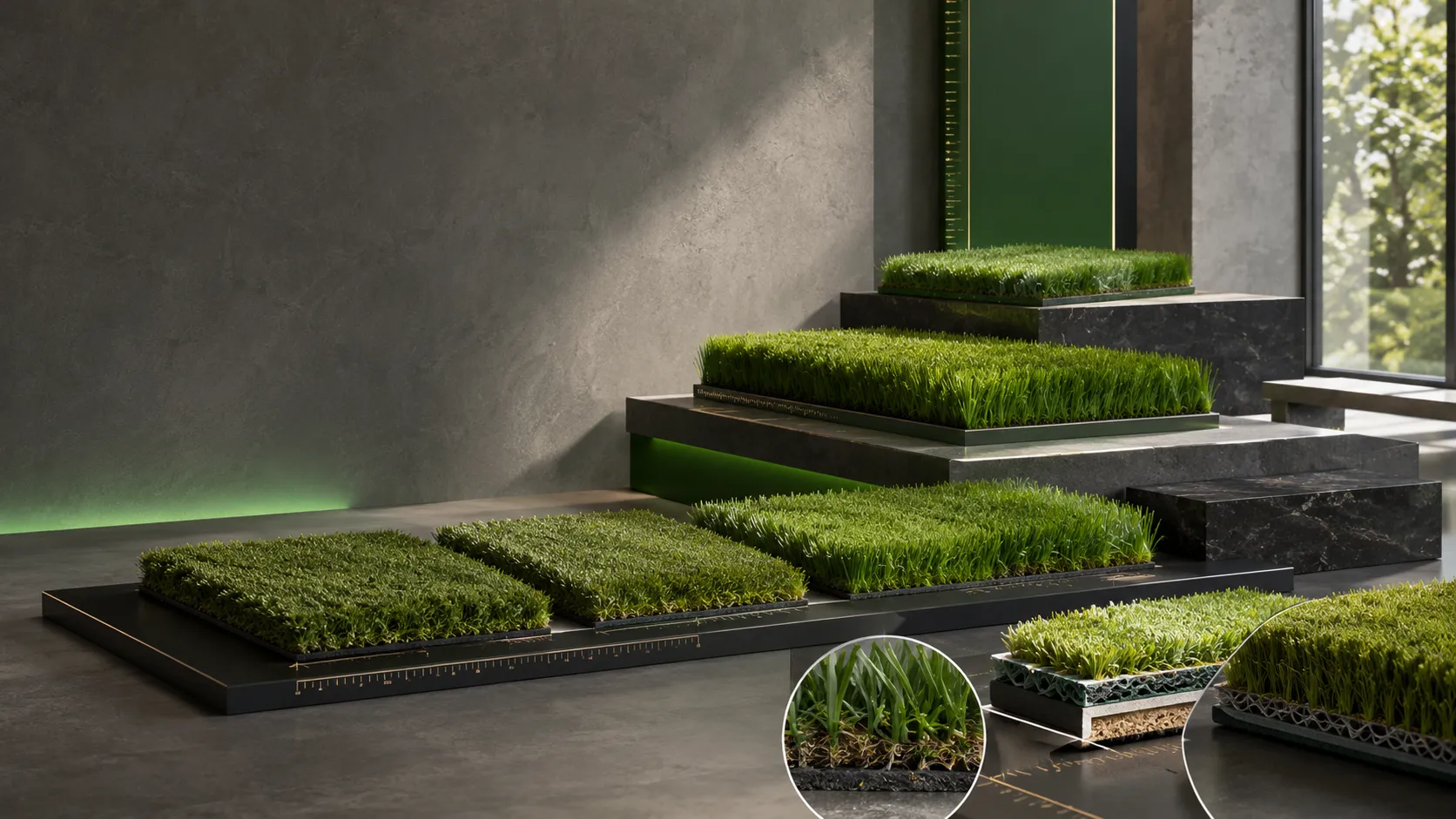
The main types of artificial grass are defined by three specifications. Pile height (blade length in mm), density (stitches per square inch) and face weight (grams of yarn per square metre). Pile height controls how the lawn looks, density controls how it wears and face weight is the clearest single indicator of overall quality. A 40mm grass at 2,700 gsm is a completely different product from a 40mm grass at 1,300 gsm, even though both are sold as 40mm.
This guide explains what each specification means, how to read them off a supplier’s spec sheet, and which combinations work in UAE conditions. It is written for villa and apartment owners in Dubai and across the Emirates who are comparing quotes and want to know whether they are being shown a good product or a cheap one.
Key Takeaways
- Pile height is the blade length, usually 20mm to 50mm. It is an aesthetic and use case choice, not a quality measure.
- Density is the number of stitches per square inch. Higher density resists matting and flattening in high traffic areas.
- Face weight is the grams of yarn per square metre. It is the most reliable single quality indicator on any spec sheet.
- UV stabilisation matters more than all three in the UAE. Without it, sun exposure degrades the fibre no matter how thick the grass is.
- For a typical Dubai villa lawn, look for 35mm to 40mm pile, high density and a face weight above roughly 2,400 gsm.
What Are the Main Types of Artificial Grass?
Artificial grass is classified first by the yarn it is made from. Only three materials are used commercially: polyethylene, polypropylene and nylon. Each behaves differently in heat, under traffic and against UV.
Polyethylene (PE), the standard for UAE lawns
Polyethylene is the most widely used yarn in landscape turf because it balances softness, durability and a realistic appearance. The blades are soft enough to walk on barefoot and hold their colour well when properly UV stabilised. Almost every residential grass sold for gardens and villa lawns in Dubai uses a PE face yarn.
Polypropylene (PP), budget grass and thatch layers
Polypropylene is the cheapest of the three and the least heat tolerant. It has a lower melting point and flattens faster under traffic, which is why quality manufacturers rarely use it for the main blade. Where it does belong is the thatch layer, the short curled fibres woven underneath the main blades to mimic the dead undergrowth of real grass and hold the taller blades upright. If a supplier quotes you an unusually cheap grass, check whether the face yarn itself is polypropylene.
Nylon (PA), putting greens and heavy traffic
Nylon is the toughest and most heat resistant yarn available, and the most expensive. It resists matting almost completely, which makes it the standard for putting greens and commercial high traffic surfaces. It is also noticeably stiffer underfoot, so it is rarely the right choice for a family lawn.
Beyond material, grass is also classified by blade shape: flat, S shape, C shape, diamond or spine. Blade shape affects how well a blade stands up under its own weight. A spined or S shaped blade at 40mm will stay upright far better than a flat blade at the same height.
Artificial Grass Pile Height Explained (mm Guide)
Pile height is the length of the grass blade measured from the backing to the tip, and it typically ranges from 20mm to 50mm. It determines how the lawn looks and feels, with shorter piles reading as neat and manicured and longer piles as lush and natural. It is not a measure of quality. Choose pile height by how the space will be used, then check density and face weight separately.
| Pile height | Imperial | Best for | UAE note |
| 20mm to 25mm | 0.8 to 1.0 in | Putting greens, pathways, balconies | Easiest to brush clean of sand and dust |
| 25mm to 30mm | 1.0 to 1.2 in | Pet areas, play zones, roof terraces | Short pile speeds up rinsing and clean up |
| 30mm to 35mm | 1.2 to 1.4 in | Family lawns, courtyards, majlis areas | Good compromise of look and practicality |
| 35mm to 40mm | 1.4 to 1.6 in | Villa gardens, front lawns, landscaping | The most popular range for Dubai villas |
| 40mm to 50mm | 1.6 to 2.0 in | Decorative, low traffic display lawns | Needs high density or the blades lean over |
What pile height is best for Dubai villas and gardens?
For most villa gardens, 35mm to 40mm is the sweet spot. It reads as a real, healthy lawn from a distance without being so long that the blades fold under their own weight. Go shorter, 25mm to 30mm, for balconies, terraces, dog runs and anywhere that sees constant footfall or needs frequent cleaning.
Does taller pile mean better grass?
No, and this is the most common misconception buyers arrive with. A 50mm grass with low density and a light face weight will splay outward and look worse after six months than a well specified 30mm product. Pile height without supporting density is just more plastic per blade, not more quality. Long pile only works when the density and face weight are high enough to hold the blades upright.
Artificial Grass Density and Stitch Rate
Density is the number of yarn stitches per square inch of backing, sometimes listed as stitch rate per 10cm, and it is what stops your lawn from matting and flattening. Think of it like thread count in bed linen. The tighter the stitching, the fuller the surface and the longer it holds its shape under traffic.
You may also see dtex on a spec sheet. Dtex measures the thickness of the individual yarn strand, defined as the weight in grams of 10,000 metres of that yarn. A higher dtex means a thicker, more robust individual blade. Density tells you how many blades there are. Dtex tells you how substantial each one is. Together they explain why two grasses at the same pile height can feel completely different in the hand.
Density is the specification that matters most in high traffic areas: entrances, pool surrounds, play zones and pet runs. A low density grass in a busy area develops visible tracks and flattened paths within a season, and no amount of brushing brings it fully back.
What Is Face Weight and Why It Matters Most
Face weight is the weight of yarn in the grass surface, expressed as grams per square metre (gsm) internationally or ounces per square yard in American spec sheets. It is the most reliable quality indicator because it combines pile height, density and yarn thickness into one number. More yarn per square metre means a denser, more durable and more realistic lawn.
Two things to watch. First, face weight excludes the backing. Some suppliers quote total weight instead, which includes the primary and secondary backing and is therefore a much larger and more flattering figure. Always ask which one you are being shown. Second, units get switched between quotes, so here is the conversion.
| Face weight (oz/sq yd) | Approx. gsm | Quality tier |
| 30 to 40 oz | 1,000 to 1,350 gsm | Entry level, sparse, short lifespan |
| 50 to 60 oz | 1,700 to 2,050 gsm | Mid range, acceptable for low traffic |
| 70 to 80 oz | 2,400 to 2,700 gsm | Good residential standard |
| 80 to 100 oz and above | 2,700 to 3,400 gsm | Premium, dense, soft, long lasting |
One ounce per square yard is about 33.9 gsm.
How to Read an Artificial Grass Spec Sheet in 60 Seconds
When you are handed a specification sheet, four numbers tell you almost everything: pile height, density, face weight and UV stabilisation. Check them in that order and ignore the product name entirely. Names like Elite and Premium are marketing, not specification.
| Specification | What it tells you | Entry level | Good | Premium |
| Pile height | Look and use case | 20 to 25mm | 30 to 40mm | 35 to 45mm |
| Density | Resistance to matting | Low | Medium to high | High |
| Face weight | Overall quality | Under 1,400 gsm | 2,000 to 2,700 gsm | Above 2,700 gsm |
| Dtex | Individual blade strength | Low | Medium | High |
| UV stabilisation | Lifespan in UAE sun | Not stated | Stated | Stated with warranty |
| Backing | Drainage and stability | Basic latex | Latex, perforated | PU or fully permeable |
If a supplier cannot give you face weight and UV stabilisation in writing, treat that as your answer. Those two numbers are the ones cheap imports leave off the sheet.
Send us a photo of your garden or balcony on WhatsApp and we will tell you which specification suits the space, with a free quote and no obligation.
Which Type of Artificial Grass Suits UAE Heat?
In the UAE, UV stabilisation matters more than pile height, density or face weight. Sun exposure, not foot traffic, is what ends most artificial lawns here. A UV stabilised polyethylene grass holds its colour and blade structure for years. An unstabilised one fades and turns brittle regardless of how thick it is.
There is genuine disagreement in the industry about pile height and surface temperature. Some manufacturers argue longer pile runs cooler because the canopy shades the backing and traps air beneath it. Others argue shorter pile runs cooler because there is less material to absorb heat and it sheds warmth faster. Both positions are published as fact by turf suppliers.
Our view is that pile height is not the lever that controls how hot your lawn gets. Three other factors matter far more.
- Colour. Darker olive and deep green blends absorb more heat than lighter, brighter greens. This is the easiest change to make and the most commonly overlooked.
- Infill. Standard silica sand stores heat. Coated sands and porous ceramic granules resist heat gain and are worth specifying for areas used barefoot.
- Backing permeability. A fully permeable or open weave backing lets heat escape from underneath, where a sealed backing traps it.
The practical takeaway is this. In July, any artificial lawn in direct sun will be hot underfoot in the middle of the day, the same as paving, decking or tiles. Specify a lighter colour and a cooling infill, and rinse the surface before use if children will be playing on it.
Choosing by Use: Villa Lawn, Balcony, Rooftop or Play Area
Match the specification to the space, not to the sample that feels softest in the showroom.
| Space | Pile height | Priority spec | Also specify |
| Villa garden or front lawn | 35 to 40mm | High face weight | Lighter colour, UV stabilisation |
| Balcony or terrace | 20 to 30mm | Permeable backing | Little or no infill over tiles |
| Rooftop | 25 to 35mm | Backing drainage | Wind edge fixing, lighter colour |
| Kids play area | 25 to 30mm | Density | Shockpad underlay, non toxic infill |
| Pet run | 25 to 30mm | Fully permeable backing | Odour control infill, short pile |
| Pool surround | 25 to 35mm | Drainage | Chlorine tolerant fibre, permeable backing |
| Majlis or courtyard | 30 to 40mm | Softness underfoot | Higher density for barefoot comfort |
Specification is only half of the result. A well specified grass laid over a poor sub base will ripple and open at the seams within months, which is why the base preparation matters as much as the product you choose. See our full service for artificial grass in Dubai for materials, base preparation and coverage.
Frequently Asked Questions
What is the best pile height for artificial grass in Dubai?
For villa gardens and front lawns, 35mm to 40mm gives the most realistic result while staying practical. For balconies, terraces, pet areas and children’s play zones, choose 25mm to 30mm. Shorter pile is far easier to rinse clean of dust and sand, and it resists matting in high traffic spots. Pile height should follow how the space is used, not how the sample feels in a showroom.
What pile height, density and face weight should I look for?
Look for three numbers together: a pile height matched to the space, 25mm to 30mm for traffic and 35mm to 40mm for lawns, the highest density you can afford, and a face weight above roughly 2,400 gsm for a residential lawn. All three matter, but face weight is the most reliable single indicator because it reflects how much yarn is actually in the product.
Does higher pile height mean better quality artificial grass?
No. Pile height is an aesthetic and use case choice, not a quality measure. A 50mm grass with low density and a light face weight will splay and flatten faster than a well specified 30mm product. Quality comes from density, face weight, yarn thickness and UV stabilisation. Always check those before you compare blade length between quotes.
How long does artificial grass last in Dubai?
Lifespan depends almost entirely on UV stabilisation and installation quality rather than pile height. A properly UV stabilised, professionally installed lawn holds its colour and blade structure for years in UAE conditions, while unstabilised imported grass can fade and turn brittle within a few seasons. Always ask for the UV stabilisation and warranty terms in writing before you buy.
Which artificial grass is best for balconies and rooftops?
Choose a shorter pile of 20mm to 30mm with a fully permeable backing. On tiled balconies and rooftops there is no sub base to drain into, so water has to pass straight through the backing and away. Short pile also stays upright without infill, which matters because loose infill on a hard surface migrates and blocks floor drains.
Is artificial grass safe for pets and children in the UAE?
Yes, with the right specification. Choose a 25mm to 30mm pile with a fully permeable backing so urine and rinse water drain away rather than pooling, and specify a non toxic infill. For play areas, a shockpad underlay adds fall protection. Shorter pile also makes solid waste clean up considerably easier.
Do you supply only, or supply and install across the UAE?
HomeGeek supplies and professionally installs artificial grass across Dubai and the wider UAE, including Sharjah, Ajman and Abu Dhabi. We measure on site, recommend the specification that suits your space and handle the base preparation, laying and finishing. Send us your location and we will confirm coverage and timing.
The Short Version
The types of artificial grass come down to three numbers: pile height for how it looks, density for how it wears and face weight for overall quality, with UV stabilisation deciding how long any of it lasts in UAE sun. Match the pile height to how the space is used, then compare density and face weight between quotes before you compare price.
Not sure which specification suits your space? Send a photo of your garden, balcony or rooftop to HomeGeek on WhatsApp at +971 54 228 7784 and we will recommend the right grass and send you a free, no obligation quote. Daily 10am to 10pm.





One Response