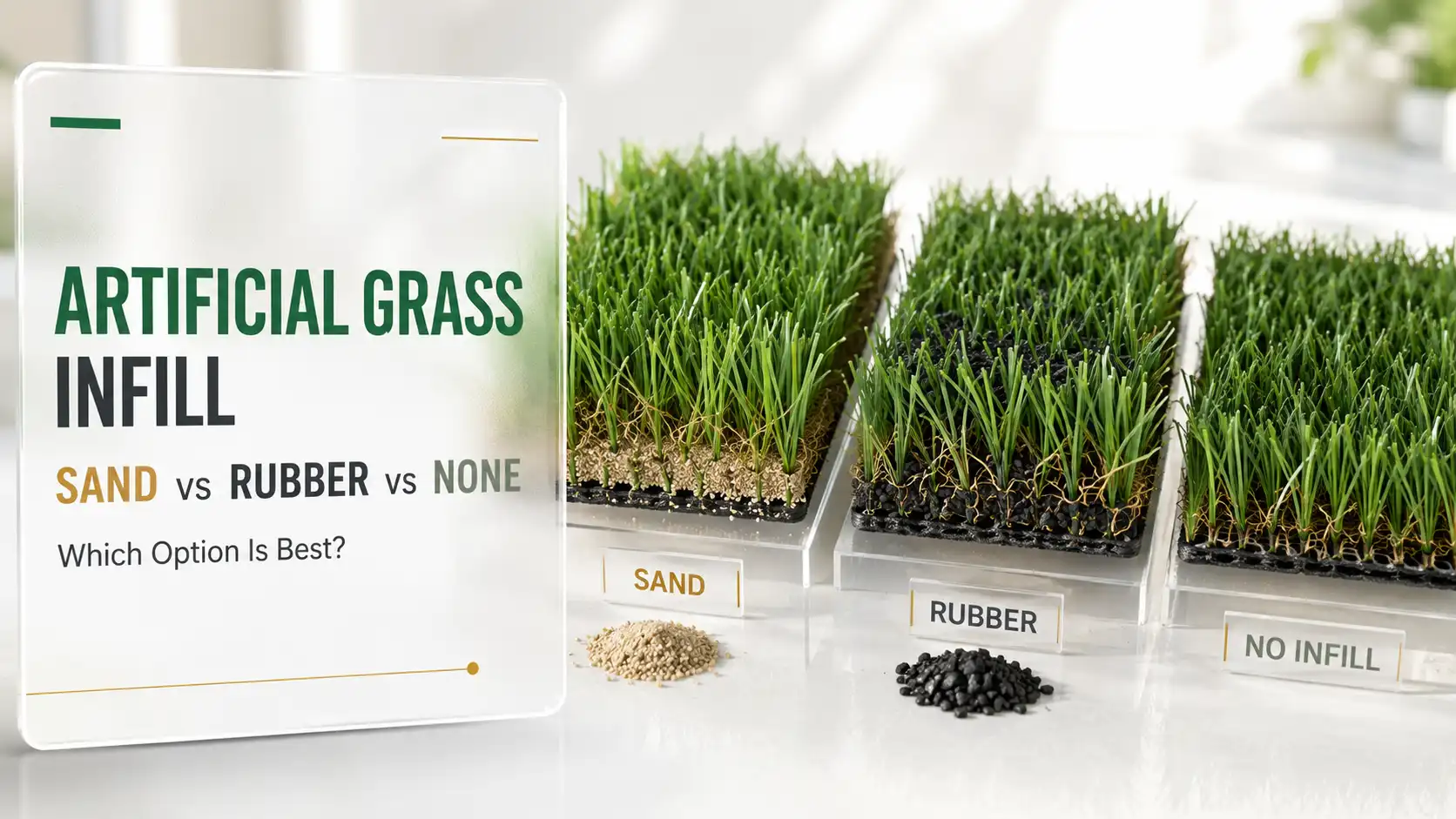
Most people never choose their infill. The installer picks it and the bags go down on fitting day. The decision only becomes visible months later, when the lawn mats down or turns uncomfortably hot.
Artificial grass infill is the granular material brushed between the blades after the turf is laid. The three practical options are sand, rubber, or none at all. Sand suits almost every residential lawn in the UAE. Rubber belongs on sports pitches rather than gardens, and no infill works only in a narrow set of conditions.
This guide covers what infill does, the honest case for and against each option, how much a lawn needs, and what your quote should say. It is written for villa and apartment owners across Dubai and the wider UAE who are comparing artificial grass installation quotes.
Key Takeaways
- Infill holds the blades upright, weighs the turf down and protects the backing from foot traffic.
- Sand is the standard choice for UAE gardens, though raw silica has sharp edges and does hold heat.
- Rubber crumb is a sports pitch product. It measures hottest in direct sun and sheds black dust.
- HomeGeek does not supply rubber infill for landscaping work.
- Going without infill works over hard surfaces with short pile, and fails almost everywhere else.
What Does Artificial Grass Infill Actually Do?
Infill does five jobs at once, and the fibres are only the first of them. It is the difference between a lawn that still looks upright after two summers and one that lies flat in the walking routes within months.
- Holds the blades upright. Granules pack around the base of each fibre and stop it folding under its own weight.
- Adds ballast. The weight keeps the sheet flat and stops it lifting at the edges in wind.
- Protects the backing. It forms a physical layer between foot traffic and the row of stitching that holds every blade in place.
- Helps the surface stay stable. It reduces rippling and movement across the area over time.
- Suppresses weeds. A filled pile gives windblown seed far less to settle into.
How much you need depends on the blade length, which means pile height, density and face weight settle the infill question before anyone opens a bag. Infill and specification are one decision, not two.
Sand Infill: The UAE Default
Sand is the most widely used infill in residential work here, and for most gardens it is the right answer. It is inexpensive, widely available and chemically inert. It is also heavy enough to ballast a lawn properly, without any of the drawbacks that come with rubber.
It is not one product, though, and the difference matters.
Raw silica sand is the cheapest grade and the one most quotes default to. Under a microscope the grains have jagged edges. On a lightly used lawn that is fine. In a high traffic area those edges gradually abrade the base of the fibres, which shortens the life of the surface. It is also more abrasive on skin if someone slides on it.
Rounded and coated sands are processed so the grains are smoother. They are gentler on the blades and better suited to entrances, pool surrounds and play zones. Some carry coatings intended to reduce heat gain or resist bacteria. They cost more per square metre, and they are worth it wherever the lawn is genuinely used.
The honest drawbacks of sand are worth stating plainly. It absorbs moisture rather than shedding it, and it holds heat. A sand filled lawn in full July sun will not feel cool underfoot.
Where odour is the main concern, a zeolite top layer over a sand base is the usual answer. Zeolite captures ammonia instead of storing it. That trade off only matters for artificial grass in pet areas, where the infill choice does more work than the turf above it.
Rubber Infill: Built for Sports, Not Villa Lawns
Rubber infill is loose black or coloured granules brushed into the pile. It exists to add bounce and shock absorption, and it comes in two forms. SBR crumb rubber is shredded from recycled car tyres and is the cheaper option. EPDM is virgin rubber, made in colours and generally regarded as the cleaner material. It costs more.
One point of confusion is worth clearing up. Rubber infill is not the same as rubber flooring or gym matting. That is a solid sheet or tile product you walk on directly. The two share a raw material and nothing else.
On a football pitch, rubber earns its place. It cushions tackles and falls in a way sand cannot, which is why it remains standard on sports surfaces worldwide.
In a Dubai garden it is a poor fit, for three reasons.
- Heat. Rubber consistently measures hottest of the common infills in direct sun. Penn State’s Center for Sports Surface Research has recorded surface temperatures across nine infilled synthetic turf systems. It found synthetic surfaces run considerably hotter than natural grass. In a climate where artificial grass already gets hot without any help, adding the warmest available infill is the wrong direction entirely.
- Black dust. Crumb rubber transfers onto shoes, clothing, furniture and pool surrounds. It also migrates indoors.
- Unsettled questions. Research into the health effects of recycled tyre crumb is ongoing, and the findings are not settled either way. We would rather not put a debated material into a family garden when a straightforward alternative exists.
HomeGeek does not supply rubber infill for landscaping installations. If a quote you have received specifies rubber crumb for a villa lawn, ask why. It is usually habit rather than a decision made for your space.
No Infill: When Is It Actually the Right Choice?
Going without infill is a real option, but a narrow one. It works when the turf is short, the surface underneath is hard, and weight is a constraint. It fails wherever the pile is long enough to fold or the sheet needs ballast to stay put.
It genuinely works in these conditions:
- Short pile laid directly over tiles, concrete or a roof deck, where there is no sub base to hold anything.
- Small areas with a fixed perimeter, where edging and adhesive do the work that ballast would otherwise do.
- Upper floors with a weight limit, since infill adds real load across a full terrace.
- Surfaces over a floor drain, where loose granules would migrate into the drain and block it.
That last point is the one people miss. On a balcony there is no soil for anything to soak into, so the drain does all the work. Infill washing towards it creates the exact problem you were trying to avoid. Most of the artificial grass drainage problems we are called to fix start with a detail settled before installation, not with the turf.
It fails in these conditions:
- Longer pile, which folds and mats without support at the base.
- Open or exposed areas, where wind lifts an unballasted sheet at the edges.
- Ground level lawns over soil, where the sheet needs weight to stay flat.
- Anywhere with regular foot traffic, since the backing takes the wear directly.
It is why artificial grass on balconies and terraces is normally specified with minimal infill and a fixed perimeter instead, letting the edging do the work that ballast would do on soil.
Sand vs Rubber vs No Infill: Side by Side
Set against each other, the three options separate quickly. Heat behaviour and foot traffic are the two factors that decide most UAE installations. Sand wins on balance for gardens. Rubber wins only where shock absorption matters. Going without wins only where there is no base underneath to hold anything.
| Sand | Rubber | No infill | |
| Holds blades upright | Yes, reliably | Yes | No |
| Ballast against wind | Good | Good | None, relies on fixing |
| Shock absorption | Low | High | Low |
| Heat in direct sun | Holds heat | Hottest of the three | Depends on the surface below |
| Mess and transfer | Minimal | Black dust on shoes and furniture | None |
| Cost | Lowest | Higher than raw sand | No material cost |
| Best suited to | Most residential lawns | Sports pitches | Short pile over hard surfaces |
| Supplied by HomeGeek | Yes | No | Yes, where suitable |
Matching that to the space you are covering is more useful than picking a favourite.
| Space | Usual answer | Why |
| Villa garden or front lawn | Sand | Ballast and blade support over a soil base |
| Balcony or terrace | Little or none | No sub base, drains must stay clear |
| Rooftop | Little or none | Weight limits and exposure to wind |
| Kids play area | Rounded or coated sand | Gentler on skin than raw silica |
| Pet run | Sand base with a zeolite top layer | Ammonia control rather than ballast alone |
| Pool surround | Rounded or coated sand | Wet feet and constant traffic |
| Football pitch | Rubber | Shock absorption for falls and tackles |
How Much Infill Does a Lawn Need?
Infill quantity is set by pile height, not by area alone. The industry works to roughly 1.5 to 4 pounds per square foot, which converts to about 7 to 20 kg per square metre. Shorter pile sits at the lower end and longer pile needs more to reach the base of every blade.
Getting the quantity wrong shows up in two opposite ways. Too little and the fibres have nothing packing them upright, so the lawn mats along the routes people walk. Too much and the surface feels hard and granular underfoot, and the excess works its way to the top where you can see it.
This is also why infill goes down as the last stage of the artificial grass installation process, spread evenly and then brushed against the direction of the pile so the blades lift as the granules settle.
Not sure which infill your space needs? Send a photo of your garden, balcony or rooftop on WhatsApp at +971 50 574 1557 and we will tell you what suits it, with a free quote and no obligation.
What the Infill Line Should Say on Your Quote
Infill is one of the easiest lines to leave vague, and vague usually means the cheapest option by default. A quote should name the material rather than listing “infill” as a single line item. It should also state how much is going down. Those two details are what make one quote comparable to another.
Check that your quote states each of these:
- The infill type by name, such as raw silica, rounded sand or a coated grade.
- The quantity or application rate, so you can check it against the pile height.
- Whether the infill is included in the price or charged separately.
- Whether any top layer, such as zeolite, is a separate line.
- That no infill is being used, if that is the plan, and why.
A quote that says only “infill included” tells you nothing about what is going into your lawn. Ask for the material by name before you compare anything, because infill is one of several lines where a low artificial grass installation cost usually signals a smaller scope of work rather than a better rate.
Frequently Asked Questions
Do you really need infill for artificial grass?
For most lawns, yes. Infill keeps the blades upright, adds the weight that holds the sheet flat, and protects the backing from foot traffic. Without it, longer pile mats down and the edges lift in wind. The exception is short pile laid over tiles or a roof deck, where fixing and edging do the same job instead.
What is the best infill for artificial grass in the UAE?
Sand suits most residential lawns here, with a rounded or coated grade preferred wherever the area is actually used rather than just looked at. Coated sands gain less heat than raw silica. Pet areas usually take a sand base with a zeolite top layer. Rubber is not a sensible choice for a garden in this climate.
Is sand or rubber infill better?
It depends entirely on the surface. Rubber is better on a sports pitch, because it absorbs the shock of falls and tackles in a way sand cannot. Sand is better for every normal garden, since it does not shed black dust, does not migrate indoors, and does not run as hot in direct sun as rubber crumb does.
How much infill does artificial grass need per square metre?
Roughly 7 to 20 kg per square metre, converting the standard industry range of 1.5 to 4 pounds per square foot. Pile height sets where you land within that. A short 25mm turf needs far less than a 40mm lawn, because the granules only need to reach the base of the blades rather than fill the whole pile.
Can you add infill after the grass has already been installed?
Yes, and it is a common fix for a lawn that has started to look flat. The pile is brushed upright first, then infill is spread evenly and worked down to the base with a stiff brush. It will not repair fibres already damaged by traffic, but it restores support and appearance on turf that is otherwise sound.
Does artificial grass infill wash away or need topping up?
Some settling and loss is normal over the years, particularly on slopes, near drains and in areas rinsed often. Most lawns benefit from a top up at some point. If you are losing infill quickly, the usual cause is a fall that is too steep or water running across the surface rather than through it, so the drainage is worth checking first.
Choosing the Right Infill
Artificial grass infill is a smaller decision than the turf itself. It is also the one most likely to be made for you by default. Sand is the sensible choice for the great majority of UAE gardens. Rubber belongs on a pitch rather than a lawn, and going without it makes sense only over hard surfaces with short pile.
Ask any supplier to name the material and the rate on the quote before you compare prices. If you want a recommendation for your own space, send a photo on WhatsApp to +971 50 574 1557. You can also reach the team through our contact page, daily from 10am to 10pm, and we will come back with a free quote.