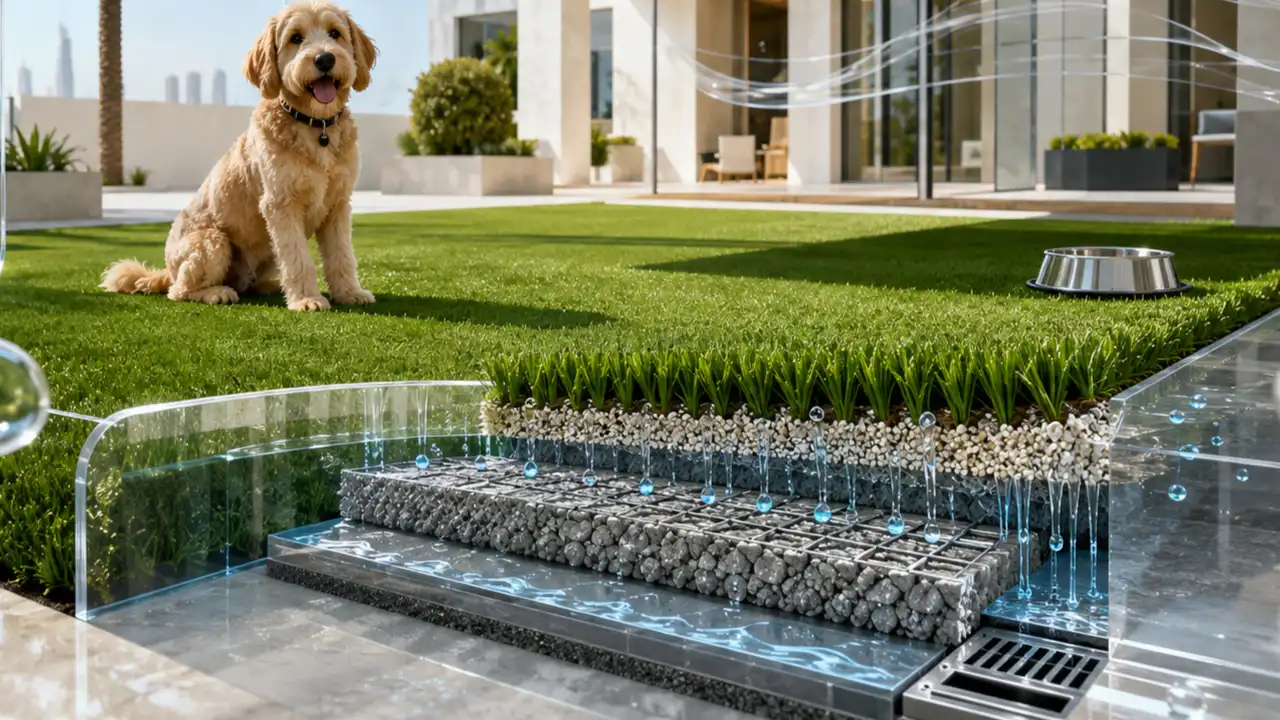
Every pet owner in Dubai hits the same breaking point: yellow patches, dug-up corners, and a smell that worsens with the heat.
Artificial grass for pets works when the whole system drains, not just the turf. Odour comes from urine trapped under the backing, so the infill matters more than the fibre. Zeolite neutralises ammonia. Plain silica sand holds it. This guide covers spec, AED costs, cleaning and summer paw safety.
Most of what makes artificial grass in Dubai work applies to any garden, but pet households face three problems nobody else does: ammonia, digging and paws on a hot surface.
Key Takeaways
- Urine does not damage synthetic fibres. It causes odour by sitting in the infill and base below.
- Zeolite infill neutralises ammonia. Silica sand, the common default, absorbs and holds it.
- A 25mm to 35mm pile suits pets best, since waste is easier to spot and rinse away.
- Pet turf in the UAE runs about AED 60 to 130 per square metre supplied and installed.
- Turf gets hot in direct sun. Use the seven second hand test before letting a dog onto it.
What Makes Artificial Grass for Pets Different?
A “pet friendly” label on a roll of turf means very little on its own. What makes a lawn work for a dog or cat is the full system: the backing, the base underneath, the seams, the edges and the infill. Urine has to pass through all of it and keep moving.
If liquid stops anywhere along that path, odour returns no matter how often you rinse the surface, which makes this a preparation problem rather than a product problem.
What to check on any quote:
- Backing. Permeable or perforated, with a stated drainage rate for that product.
- Base. Free draining and compacted, with a gentle fall so water leaves the area.
- Seams and edges. Tight joins and a secured perimeter, since loose edges invite digging.
- Fibres. Resilient yarn that stands back up after a dog runs the same route daily.
- Infill. Chosen for odour control rather than cost.
On a balcony there is no soil, so the floor drain does all the work, and turf laid over a drain will smell within weeks. Nearly every artificial grass drainage failure we are called out to fix traces back to a decision made before installation rather than to the turf itself.
Why Does Artificial Grass Smell of Dog Urine?
The turf itself is odour neutral, and the smell actually comes from urine residue that collects between the backing and the layer below, where it breaks down into ammonia. Heat accelerates that reaction, which is why a lawn that seemed fine in February becomes obvious in July. Dogs also return to the same corner every time, which concentrates the problem into one small area instead of spreading it.
Infill is the part most people get wrong
Infill sits between the fibres and holds them upright. It also decides what happens to urine once it drains through.
Silica sand is the standard, cheapest option, and although it supports the pile well, it is absorbent enough to hold urine residue for months and release the smell again in hot weather.
Zeolite is a natural mineral with a porous structure that captures and neutralises ammonia instead of storing it. It costs more per square metre, but in a pet area it is the difference between rinsing a lawn and replacing one.
If your installer quotes silica sand for a dog area without mentioning zeolite, ask why, because most quotes default to sand on price rather than suitability.
One honest note: no infill makes a lawn permanently odour free, and while zeolite buys you time between cleans, it does not replace proper drainage or a regular routine.
What Pile Height and Spec Suit Dogs and Cats?
Shorter is better for pets, because a 25mm to 35mm pile lets you see solid waste, pick it up cleanly and rinse the spot properly. A deep 50mm lawn looks lush in photos and hides everything you need to find. Of the three specs that matter, pile height, density and face weight, density is the one to prioritise, because a dense short pile recovers better from a dog running the same path daily.
| Situation | Suggested pile | Why |
| One or two dogs, villa garden | 25mm to 35mm | Easy waste removal, dense enough for comfort |
| Multiple dogs or a dog run | 25mm | Highest traffic, needs the fastest clean down |
| Cats only, courtyard or terrace | 30mm to 35mm | Softer underfoot, lighter soiling than dogs |
| Apartment balcony toilet area | 25mm | Drainage access and rinsing matter more than looks |
| Mixed family and pet lawn | 35mm | Balances appearance with practical cleaning |
Cats soil less than dogs but claw at edges and often use one spot as a litter area, so secure edging matters more than pile height for a cat household.
Most pet installs from the HomeGeek artificial grass range land at 25mm or 35mm, and we bring samples of both to a site visit so you can feel the difference first.
How Much Does Pet Friendly Artificial Grass Cost in Dubai?
Pet spec artificial grass in the UAE generally runs AED 60 to 130 per square metre supplied and installed, depending on the turf grade, the base preparation your site needs and whether you choose zeolite infill.
| Item | Typical UAE range | Notes |
| Pet spec turf, supply only | AED 30 to 80 per sqm | Varies by density and backing quality |
| Installation labour | AED 15 to 35 per sqm | Higher for balconies and awkward access |
| Supplied and installed | AED 60 to 130 per sqm | The figure most quotes are based on |
| Zeolite infill | Quoted separately | Priced by area and application rate |
| Base preparation | Site specific | Excavation, drainage correction, edging |
Prices vary by size and site condition, so send us your area and a photo for an exact figure.
Four things push a pet lawn above the standard artificial grass installation cost in Dubai: a balcony drain that needs working around, a garden with no existing fall, an area under 20 square metres, and a site that needs old grass removed first.
Send a photo of your garden or balcony on WhatsApp and we will come back with a free, no obligation quote. Most quotes go out the same day. +971 50 574 1557.
How Do You Keep Pet Turf Clean and Hygienic?
A pet lawn needs a routine, not a deep clean every weekend. The aim is to move residue through the system before it dries into the fibres. A workable routine for a UAE household:
- Daily. Pick up solid waste rather than leaving it, because it stains and breeds bacteria quickly in the heat.
- Twice weekly. Rinse the toilet area with a hose so residue drains through the system rather than drying on the pile.
- Weekly. Brush the pile with a stiff, non metal brush so the blades stand upright and debris does not mat down.
- Monthly. Use a pet safe enzyme cleaner made for artificial turf, since enzymes break down ammonia at the source, and follow the label for dilution and rinsing.
- Seasonally. Inspect drains, low points, seams and edges, because repeat odour usually traces back to one of those four.
Skip bleach, disinfectant and pressure washing, which can damage the backing and adhesive and may void the warranty, and never mix cleaning chemicals.
Heat accelerates ammonia, so the artificial grass cleaning routine that keeps a lawn fresh in January will not be enough in July. Expect to rinse a pet area two or three times as often through summer.
If the smell keeps returning despite the routine, stop buying cleaner. It is a drainage or infill problem and needs an inspection.
Is Artificial Grass Too Hot for Paws in Dubai Summer?
Yes, it can be, because artificial grass gets hot in direct sun and in one university comparison of six outdoor surfaces it measured hottest in all four test runs. Any supplier calling their turf “cool” without a product specific test is overselling.
Use the seven second test by placing the back of your hand flat on the surface, and if you cannot hold it there comfortably for seven seconds, it is too hot for paws.
Practical steps for a Dubai garden or balcony:
- Give your pet shade over part of the lawn and constant access to water.
- Move walks and play to early morning or after sunset in summer.
- Rinse the surface with a hose to cool it, then check it again before use.
- Keep a cool indoor route so your dog is not crossing hot tiles to reach the turf.
If your dog limps, licks its paws repeatedly, or you see red or blistered pads, move it off the surface, cool the paws with water rather than ice, and speak to a vet.
Frequently Asked Questions
Does artificial grass smell when a dog urinates on it?
The turf itself does not smell, and odour only appears when urine residue collects in the infill or the base below the backing and breaks down into ammonia. Good drainage and zeolite infill prevent most of it. If a lawn smells within weeks of installation, the cause is usually a blocked drain, a flat installation or absorbent infill rather than the grass.
How do you clean dog urine off artificial grass?
Rinse the area with a hose so residue passes through the drainage system instead of drying onto the fibres. When water alone is not enough, use a pet safe enzyme cleaner made for artificial turf and follow the label for dilution and rinsing. Brush the pile once it is dry, and avoid bleach, disinfectant and pressure washing entirely.
How much does pet friendly artificial grass cost in Dubai?
Pet spec artificial grass in the UAE typically costs AED 60 to 130 per square metre supplied and installed. Turf grade, base preparation and zeolite infill move the figure. Balconies and small areas usually sit higher per square metre because fixed costs spread across less space. Prices vary by site, so send photos and dimensions for an accurate quote.
Does artificial grass get too hot for dog paws in summer?
It can. Artificial grass absorbs heat in direct sun and can get hotter than natural grass. Check it with the back of your hand before letting your dog onto it. If you cannot hold your hand there for seven seconds, it is too hot. Provide shade and water, rinse the surface to cool it, and avoid midday in summer.
What pile height is best for dogs?
A 25mm to 35mm pile works best, because shorter fibres make solid waste easier to see, pick up and rinse away, and they drain faster. Deep 50mm turf looks impressive but hides waste and holds residue. Density matters more than height, since a dense short pile recovers better from a dog running the same route every day.
Is artificial grass safe for cats as well as dogs?
Yes, and the system requirements are the same: permeable backing, free draining base and secure edges. Cats soil less than dogs but tend to claw at borders and use one spot repeatedly. Secure edging matters more for a cat household than pile height. Keep any offcuts away after installation, as cats and kittens may chew loose material.
Will my dog dig it up or chew the edges?
A well fixed lawn resists digging far better than natural grass, but no turf is dig proof and we will not claim otherwise. Most damage starts at a loose edge or seam. A secured perimeter, tight joins and removal of offcuts after installation prevent nearly all of it. Tell your installer if your dog digs or chews so the edges are specified accordingly.
Ready to Sort Your Pet Lawn?
Artificial grass for pets comes down to three decisions: a system that drains properly, zeolite infill instead of plain sand, and a short pile you can actually clean. Get those right and the odour problem never starts.
HomeGeek has supplied and installed artificial grass across Dubai and the UAE since 2015, with our own teams and no subcontractors.
Send a photo of your space on WhatsApp at +971 50 574 1557 for a free quote, or book a free site visit and measurement and see real samples before you decide.