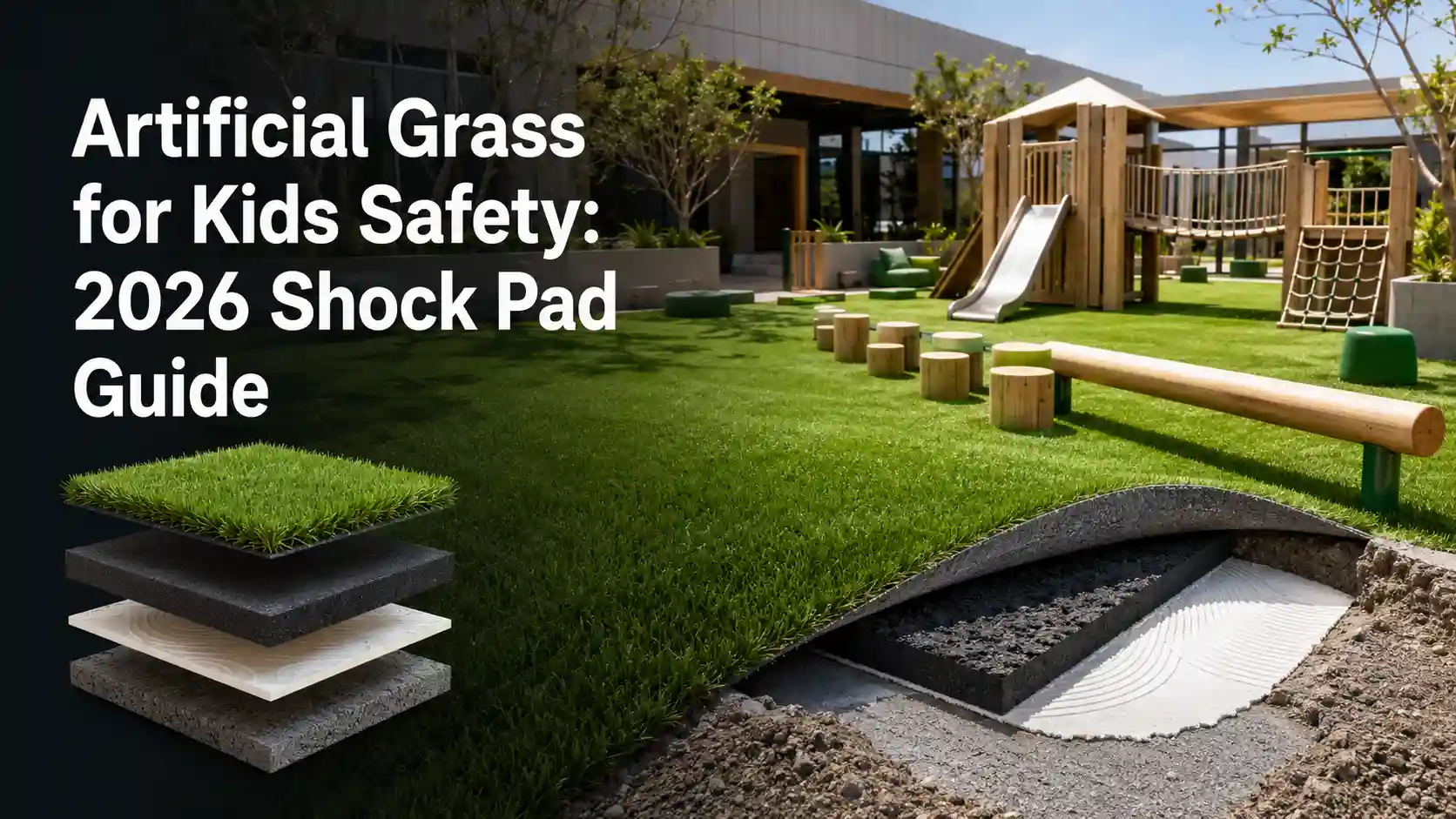
Most parents shopping for play area turf ask about the grass. The grass is rarely the part that protects a child.
Artificial grass for kids safety comes down to what sits underneath the turf, not the turf itself. Synthetic grass laid straight onto a compacted base gives a critical fall height of roughly 0.9 metres. Add a certified shock pad and that rating climbs to between 1.3 and 3.0 metres, depending on pad thickness. The second safety factor is infill: silica sand and cork are safe choices, crumb rubber is not.
This guide covers what a shock pad does, which thickness matches your equipment height, how EN 1177 applies to play areas in Dubai, which infill and turf specs to insist on, and how to stop the surface getting too hot in UAE summer. It is written for villa owners, nurseries and schools across Dubai and the wider UAE who are planning artificial grass for kids play areas in Dubai.
Key Takeaways
- Turf alone protects a fall of about 0.9 metres. The shock pad does the real work.
- Pad thickness sets the rating: 25mm gives roughly 1.3m, 35mm roughly 1.9m, 45mm roughly 2.5m.
- Dubai Municipality, Trakhees, KHDA and ADEK all recognise EN 1176 and EN 1177 as the minimum standard.
- Ask for silica sand or cork infill and an EN 71-3 certificate. Refuse crumb rubber for children.
- Turf surfaces can pass 50 degrees Celsius in direct Dubai sun. Cooling infill and shade fix that, not the grass alone.
Is Artificial Grass Safe for Kids? What Actually Matters
Modern artificial grass is safe for children when the full system is specified properly. The polyethylene fibre itself is inert and does not off-gas in normal use. Almost every real safety problem in a play area traces back to one of three things: the infill, the base build, or the absence of a shock pad.
Older and cheaper installations often use crumb rubber infill made from recycled tyres. Testing has found lead, zinc, chromium, polycyclic aromatic hydrocarbons and BPA in crumb rubber. Research groups have flagged that a portion of the chemicals identified in it are known or suspected carcinogens. None of that belongs in a space where toddlers crawl and put hands in their mouths.
The second issue is the base. A play area built on loose sand or an uneven sub-base develops dips and ridges within a season. Children trip on the ridges, and water sits in the dips. Neither is a fault of the grass.
If your question is more about chemicals and hygiene than fall protection, we cover whether artificial grass is safe for kids in more depth in a separate guide.
What Is a Shock Pad and Why Kids Play Areas Need One
A shock pad is a closed-cell foam layer installed between the compacted base and the turf. Its only job is to absorb impact energy when a child falls, so the force reaching the head drops to a survivable level.
Playground surfaces are rated by critical fall height, or CFH. This is the maximum height a child can fall from onto that surface without a life-threatening head injury. It is measured with a Head Injury Criterion test: a weighted headform shaped like a human skull is dropped from increasing heights until the reading reaches HIC 1,000. The height at which that happens becomes the certified CFH.
Artificial grass with no pad underneath typically tests at around 0.9 metres. That is lower than the seat of a small swing, lower than the platform on most garden climbing frames, and lower than the top of a trampoline surround. In other words, unpadded turf is soft to the touch but offers almost no fall protection.
This is where a lot of UAE installations quietly fail. A thick, long pile turf feels plush underfoot, and buyers assume plush means protective. It does not. Pile height affects how the surface looks and feels. Pad thickness affects whether a child walks away from a fall.
Shock Pad Thickness and Critical Fall Height
Match the pad to the highest point a child can fall from, not to your budget. Measure from the highest standing or sitting surface on the equipment down to the ground, then specify a pad rated at or above that figure.
| Shock pad thickness | Approximate certified CFH | Suitable for |
| No pad (turf only) | About 0.9m | Lawns, pathways, general garden turf. Not play equipment. |
| 25mm | 1.3m to 1.4m | Toddler areas, low play panels, sand and water tables |
| 35mm | Around 1.9m | Standard garden climbing frames, small slides, swings |
| 45mm | Up to 2.5m | Multi-level play structures, taller slides, nursery playgrounds |
| Layered systems (for example 25mm doubled) | Up to 3.0m | High equipment. 3.0m is the maximum recognised under EN 1177. |
Figures are typical certified ranges for tested pad and turf systems. Actual ratings depend on the specific pad, the turf laid over it and the groundworks beneath, so always ask for the test certificate covering the exact combination being installed.
One detail installers skip: the pad must extend across the whole fall zone, not just directly under the equipment. EN 1177 fall zones normally reach at least 1.5 metres out from the equipment in every direction, and further for swings and slides.
Planning a play area? Send a photo of your space and the height of your equipment on WhatsApp and our team will tell you which pad thickness you actually need, with a free no-obligation quote. Most quotes come back in minutes.
EN 1177 and Dubai Playground Rules Parents Should Know
Play area surfacing in the UAE is not unregulated. EN 1176 covers playground equipment and EN 1177 covers impact-attenuating surfacing beneath and around that equipment. Dubai Municipality, Trakhees, KHDA and ADEK all recognise these standards as the compliance baseline for public, school and community play areas.
The EN 1177 pass criteria are specific: the surface must return a HIC value below 1,000 and a peak deceleration under 200g at the actual fall height of the installed equipment. A certificate that does not name a fall height is not telling you anything useful.
Private villa gardens in Dubai are not inspected the way a school or community playground is. That does not make the standard irrelevant. It is the only objective benchmark available, and specifying to it costs very little more than not doing so.
Schools and nurseries have no choice. If you are specifying for an education setting, the paperwork matters as much as the surface, and our artificial grass for schools and nurseries service covers certified pad systems and documentation.
Safe Infill and Turf Specs for Children
Infill sits between the fibres to hold the turf blades upright, add ballast and improve drainage. For a children’s area, the material you choose matters more than any other single product decision.
| Infill type | Suitable for kids | Notes |
| Rounded silica sand | Yes | The standard safe choice. Inert, stable, widely available in the UAE. |
| Organic cork or coconut | Yes | Runs cooler than sand. Costs more and may need topping up over time. |
| Coated cooling silica | Yes | Reflective coating reduces surface temperature. Good for exposed UAE gardens. |
| Crumb rubber (recycled tyre) | No | Associated with lead, zinc, PAHs and BPA. Avoid entirely in children’s areas. |
| No infill at all | Not ideal | Blades flatten quickly and the turf can ripple underfoot. |
Ask your supplier for an EN 71-3 certificate. That is the European toy safety standard covering migration of heavy metals such as lead, and it is the most relevant test for a surface children touch daily. A supplier who cannot produce one should not be laying a play area.
On the turf itself, a pile height of roughly 25mm to 35mm with high stitch density works better for play areas than a longer, softer pile. Shorter dense turf recovers its shape under constant running, drains faster and does not trap as much debris. Long pile turf in a play area looks impressive on day one and flattens into matted tracks by month six.
Does Artificial Grass Get Too Hot for Kids in Dubai?
Yes, it can, and this is the most common complaint from UAE parents. Synthetic surfaces in direct Dubai sun regularly exceed 50 degrees Celsius, which is hotter than the surrounding air and hot enough to be uncomfortable on bare feet and hands.
Three measures deal with it. Cooling infill, meaning coated silica or organic cork, can reduce surface temperature by up to around 10 degrees Celsius. Shade is more effective still: temperatures under a fabric or steel shade structure typically run 8 to 10 degrees cooler than open ground beside it. A brief rinse with a hose before play drops the surface temperature immediately, though the effect fades as the water evaporates.
The practical answer for most Dubai villas is a combination. Specify cooling infill at installation, put shade nets over the play zone, and keep peak summer play to mornings and evenings. We explain the physics behind it in more detail in our guide on does artificial grass get hot in UAE sun.
Installation and Upkeep That Keeps a Play Area Safe
A certified pad installed badly is not a certified surface. Use this checklist before signing off any play area installation.
| Check | Why it matters |
| Compacted, level sub-base | Prevents dips, ridges and trip points forming in the first season |
| Free-draining aggregate layer | Stops standing water, odour and bacteria after rain or spills |
| Shock pad across the full fall zone | Protection stops where the pad stops |
| Heat-welded or properly glued seams | Lifted seams are the most common trip hazard in play areas |
| Secured perimeter edging | Stops children peeling back the turf edge |
| Test certificate naming pad, turf and fall height | The only proof your surface actually meets its claimed rating |
Ongoing care is light. Brush the pile against the lay direction every few weeks to keep it upright, rinse dust and sand off regularly, and clear debris before it works into the infill. Our full artificial grass installation process guide walks through the build stages, and if water is pooling anywhere on the surface, read our notes on artificial grass drainage issues before it turns into an odour problem.
Frequently Asked Questions
Is artificial grass safe for children?
Yes, when it is specified correctly. Modern polyethylene turf fibre is inert and non-toxic. The safety risks come from crumb rubber infill, a poorly built base, and the absence of a shock pad under play equipment. Choose silica sand or cork infill, ask for an EN 71-3 certificate, and add a certified pad wherever children can fall from height.
Do I really need a shock pad under artificial grass for kids?
If there is any play equipment, yes. Turf laid without a pad tests at a critical fall height of only about 0.9 metres, which is less than the height of most garden swings and climbing frames. For a flat lawn area with no equipment, a pad is optional. For anything a child climbs on, it is the single most important component.
How thick should a playground shock pad be?
Match it to your equipment. A 25mm pad covers falls up to roughly 1.3 to 1.4 metres, 35mm covers around 1.9 metres, and 45mm covers up to about 2.5 metres. Measure from the highest standing surface on the equipment to the ground, then choose a pad certified at or above that height.
What infill is safest for a children’s play area?
Rounded silica sand is the standard safe option, and organic cork or coated cooling silica are good alternatives that also run cooler in UAE heat. Avoid crumb rubber made from recycled tyres, which has been found to contain lead, zinc, PAHs and BPA. Always request an EN 71-3 heavy metals certificate.
Does a home play area in Dubai have to meet EN 1177?
Private villa gardens are not routinely inspected against it, so there is no legal requirement in the way there is for schools and public playgrounds. Even so, EN 1177 is the only objective measure of fall protection available, and Dubai Municipality, Trakhees, KHDA and ADEK all recognise it. Specifying to it is the sensible choice.
Is playground turf hygienic for toddlers and pets?
Yes, provided drainage is built correctly. A free-draining aggregate base and a permeable backing let liquid pass straight through rather than sitting in the pile. Rinse the surface regularly and clear solids promptly. Our guide on how to clean artificial grass covers the full routine for UAE conditions.
How long does a kids play area turf installation take?
Most residential play areas in Dubai are completed in one to two days once the base is prepared, depending on size and whether existing surfacing needs removing. Larger nursery and school projects take longer because of fall zone measurement and certification requirements.
The Bottom Line
Artificial grass for kids safety is a system question, not a product question. The turf you can see matters far less than the shock pad, the infill and the base underneath it. Get the pad thickness matched to your equipment height, insist on non-toxic infill with an EN 71-3 certificate, and plan for UAE heat with cooling infill and shade.
HomeGeek has been supplying and installing artificial grass installation in Dubai since 2015, with our own in-house team and a written warranty on materials and workmanship. Send a photo of your space and the height of your play equipment to our team on WhatsApp at +971 54 228 7784 for a free, no-obligation quote, or book a free on-site measurement and see real turf and pad samples before you decide.