
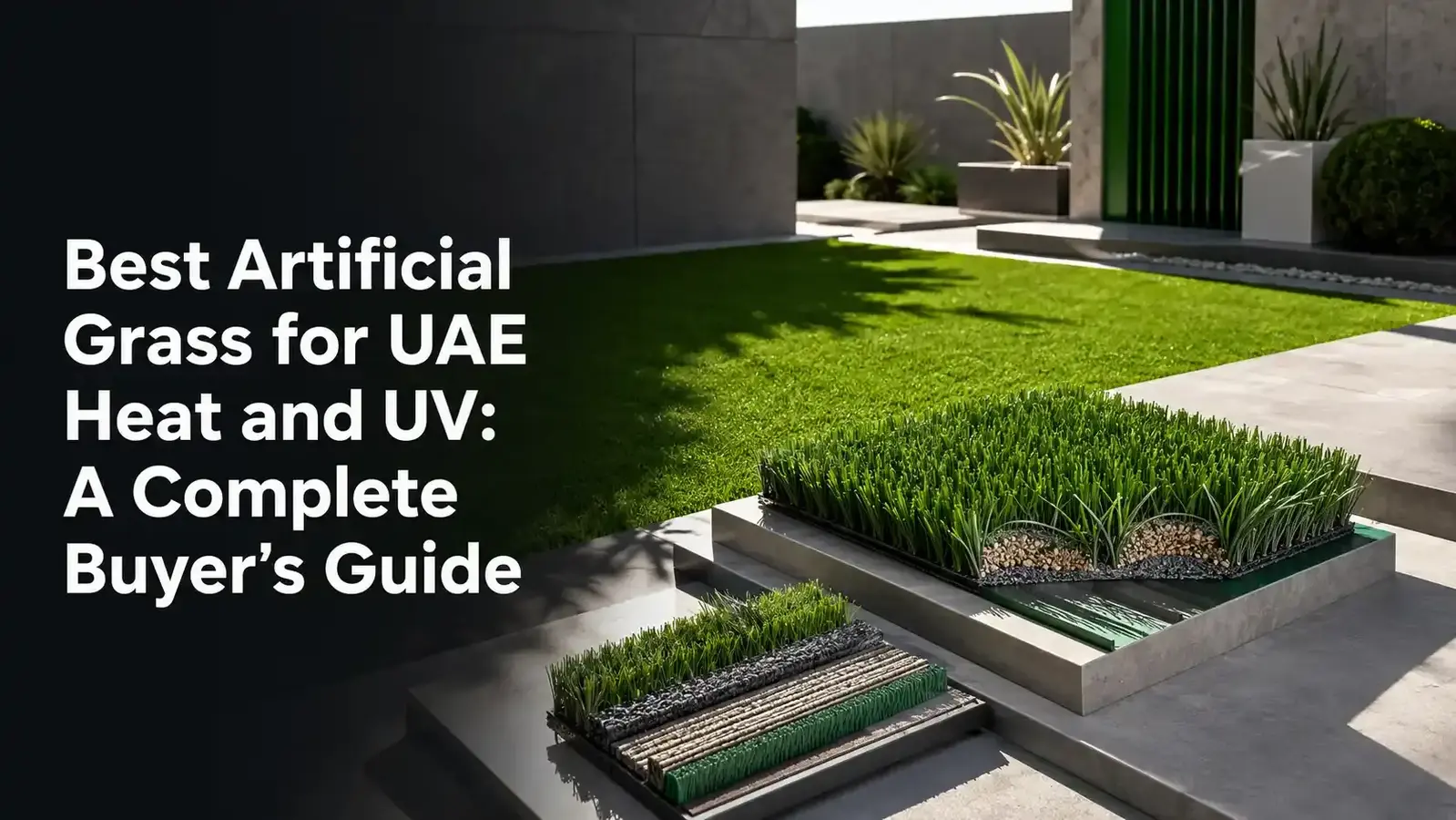
The best artificial grass for UAE conditions is a UV stabilised turf with C-shaped or W-shaped fibres, a permeable backing, and a pile height between 35mm and 50mm for residential use. That combination resists fading, sheds heat faster, and drains instantly when the rare rain arrives.
Most artificial grass sold worldwide is designed for mild climates, tested in places where summer means 28 degrees Celsius. Bring that same roll to Dubai, Sharjah, or Abu Dhabi and it starts failing within two summers. The green turns pale, the fibres go stiff, and the backing begins to crumble. Choosing turf here is a different decision entirely.
What Makes Artificial Grass “Best” for UAE Heat and UV
Six specifications separate turf that survives a decade here from turf that looks tired after eighteen months:
- UV stabiliser mixed into the yarn itself, not sprayed on top
- Fibre shape engineered to release heat rather than trap it
- A backing that stays flexible and bonded at high temperatures
- Fast, unrestricted drainage
- Pile height and density matched to how the space is actually used
- Infill chosen for temperature control, not just for weight
Everything else, including colour tone, blade texture, and thatch layer, is a matter of taste. These six are matters of survival.
How UAE Heat and UV Actually Damage Artificial Grass
Understanding the failure modes makes the specifications easier to judge.
UV degradation and fading
Ultraviolet radiation breaks the polymer chains in polyethylene fibres. As those chains break, the pigment loses its anchor and the colour lifts, shifting the turf from deep green towards a washed-out yellow-green. The UAE receives some of the highest annual solar radiation on the planet, so this runs faster here than almost anywhere else.
Heat build-up on the surface
Synthetic fibres absorb solar energy and, unlike living grass, cannot cool themselves through transpiration. On a still July afternoon, a dark, dense, flat-bladed turf can reach surface temperatures well above the air temperature. Fibre profile and colour tone control how much heat is held and how fast it releases once the sun moves off.
Backing failure and delamination
The backing is the layer nobody inspects and the layer that fails first. Cheap latex becomes brittle under repeated heating and cooling cycles. Tufts loosen, seams lift, and the sheet starts to ripple. In a climate that swings from 45 degrees Celsius by day to 30 at night for months on end, backing quality is not a detail.
UV Stabilisation: The Single Most Important Spec
There are two ways a manufacturer can add UV protection, and the difference matters enormously.
The cheap method is a surface treatment applied after the yarn is made. It works for a season or two, then wears off through foot traffic, cleaning, and weathering. The proper method is a UV stabiliser masterbatch blended into the molten polymer before the fibre is extruded, so the protection runs through the full thickness of every blade and cannot wear away.
When comparing suppliers, ask one direct question: is the UV stabiliser in the masterbatch or applied to the surface? A supplier who cannot answer is reselling unbranded stock without specifications.
The second signal is the warranty. A manufacturer confident in their UV package offers a written colour-fastness warranty, typically eight to ten years. A vague “UV resistant” label with no warranty document behind it means nothing. Quality UV stabilised turf holds its colour for ten to fifteen years in UAE conditions.
Fibre Shape and Why It Changes Surface Temperature
Blade shape is the specification most buyers never ask about, and it has a direct effect on how a lawn feels underfoot in August.
Flat monofilament blades present a wide, uninterrupted surface to the sun. They absorb the most energy and hold it longest. They are also the cheapest to produce, which is why they dominate the budget end of the market.
C-shaped fibres are curved along their length. The curve stiffens the blade so it stands upright and creates air channels that let hot air escape upward instead of pooling at the surface.
W-shaped fibres take this further with multiple bends across the blade width. They resist matting, recover their shape quickly, and offer the best heat dissipation of the common profiles. For high-use residential lawns in the UAE, W-shaped is the strongest choice.
S-shaped and spine-reinforced fibres sit between C and W in performance and price, and produce a very natural look.
If you want to compare real samples side by side, the full range of artificial grass pile heights and densities shows how blade shape changes both the look and the feel of a finished lawn.
Pile Height and Density for UAE Conditions
Pile height is measured from the backing to the blade tip. Taller is not automatically better. Very long fibres in a hot climate flatten under their own weight, trap more heat between blades, and are harder to keep clean when fine desert sand settles into them.
| Pile height | Best suited to | Notes for UAE use |
| 25mm | Balconies, walkways, high foot traffic, commercial entrances | Stays upright under heavy use, easiest to rinse clean |
| 35mm | Sports areas, gyms, kids play zones | Good balance of cushioning and recovery |
| 42mm | Mixed-use gardens, poolside, terraces | Popular all-round choice for villas |
| 50mm | Villa lawns, landscaping, low to medium traffic | Lush appearance, softest underfoot |
| 60mm | Display areas, decorative lawns, luxury landscaping | Needs regular brushing to stay upright |
Density matters just as much. Stitch rate and yarn weight, usually expressed in grams per square metre, tell you how much material is actually in the roll. A dense 35mm turf outperforms a sparse 50mm turf on durability and lifespan every time. If a quote does not state the GSM, treat that as a warning.
Professional artificial grass installation in Dubai also depends on base preparation, because a compacted, free-draining sub-base is what keeps the surface flat through years of thermal expansion.
Backing, Drainage and Infill for Hot Climates
The backing should be fully permeable with punched drainage holes across the whole sheet, not just perforations at intervals. UAE rainfall is rare but intense, and water sitting under turf breeds odour and bacteria quickly in warm conditions.
Polyurethane backings outperform latex in heat. They stay flexible through thermal cycling, hold the tufts more securely, and resist the brittleness that causes shedding. For rooftops and terraces, a lightweight permeable backing keeps the load within the structure’s limits.
Infill does more than hold the turf down. Rounded silica sand adds ballast, keeps blades upright, and acts as a thermal buffer at the base of the pile. Lighter infills reflect more solar energy than dark rubber crumb, which absorbs it. Where children or pets spend time, choose light silica or a dedicated cooling infill and avoid black rubber entirely.
Best Artificial Grass by Space Type in the UAE
Different spaces place completely different demands on the same material.
Rooftops and terraces
Rooftops receive full sun with no surrounding shade and often have weight restrictions. Choose a lightweight turf around 30mm to 40mm with a highly permeable backing. Purpose-built rooftop artificial grass is designed for exactly this combination of exposure and load limits.
Kids play areas
Safety and surface temperature come first. A 35mm to 40mm pile with a shock pad underneath cushions falls, and a light silica infill keeps the surface cooler. Non-toxic, lead-free fibres with antimicrobial backing are non-negotiable. Turf specified as artificial grass for kids play area is built around these requirements.
Villa gardens and landscaping
Appearance leads here. A 42mm to 50mm pile with mixed green and beige thatch tones reads as natural from every angle. Full artificial grass landscaping in the UAE also involves edging, shaping around planters, and blending with hard surfaces.
Football pitches
Sport surfaces need 50mm to 60mm pile with high resilience and correct infill depth so the ball behaves predictably and players can slide safely. Dedicated football artificial grass is engineered to those performance standards.
Golf putting surfaces
Putting greens use short, dense, tightly tufted turf, typically 12mm to 15mm, so the ball rolls true. This is a specialist product and should never be substituted with landscaping turf.
Schools and nurseries
Constant traffic, strict safety requirements, and year-round use call for durable mid-height turf with certified non-toxic materials. Purpose-selected artificial grass for schools and nurseries handles that load.
How to Keep Artificial Grass Cool in Peak Summer
Even the best turf warms up in direct July sun. These measures make a real difference:
- Rinse before use. A brief spray with a hose drops the surface temperature immediately and the effect lasts a while as the water evaporates.
- Add shade. A pergola, canopy, or shade nets in Dubai over play areas cuts direct radiation and is the most effective long-term fix.
- Choose lighter infill. Light silica reflects more energy than dark rubber crumb.
- Time your use. Early morning and after sunset are comfortable for most of the summer, even on unshaded lawns.
- Keep blades upright. Brushing against the pile direction restores loft, and upright blades trap less heat than matted ones.
Red Flags When Buying Artificial Grass in the UAE
- No written UV or colour-fastness warranty
- No stated GSM, stitch rate, or pile height on the quote
- Unbranded rolls with no manufacturer specification sheet
- A price far below every other quote, which usually means thin backing and surface-only UV treatment
- No site visit and no physical samples before you commit
- Vague answers about base preparation, where most installation failures begin
Quick Buyer’s Checklist
Before you sign anything, confirm:
- UV stabiliser is in the masterbatch, not a surface coating
- Written colour-fastness warranty of at least eight years
- C-shaped or W-shaped fibre profile
- Fully permeable backing, polyurethane preferred
- Pile height matched to your actual use, not to the showroom display
- GSM and stitch rate stated in writing
- Light-coloured infill for play and pet areas
- Base preparation included in the quoted scope
- Physical samples seen and felt in daylight before ordering
Frequently Asked Questions
What is the best artificial grass for UAE heat?
A UV stabilised polyethylene turf with C-shaped or W-shaped fibres, a permeable polyurethane backing, and a 42mm to 50mm pile for gardens or 25mm to 35mm for high-traffic areas. The UV stabiliser must be blended into the yarn rather than applied as a coating.
Does artificial grass fade in Dubai sun?
Properly UV stabilised turf holds its colour for ten to fifteen years. Untreated or surface-treated turf begins fading noticeably in its second summer, usually starting with the most exposed section of the lawn.
How hot does artificial grass get in Dubai summer?
Like any surface in direct sun, synthetic turf warms up during peak hours. Fibre shape, colour tone, and infill choice all affect how hot it gets and how quickly it cools. Rinsing with water or adding shade brings the temperature down quickly, and evening use is comfortable throughout the year.
What pile height is best for UAE villas?
Between 42mm and 50mm suits most villa gardens. It looks lush, feels soft underfoot, and still recovers well from normal family use. Drop to 25mm or 35mm for walkways, balconies, and heavy traffic zones.
How long does artificial grass last in the UAE?
Ten to fifteen years with quality turf, professional installation, and occasional brushing and rinsing. Poor base preparation and low-grade backing are the two factors that cut that lifespan in half.
Is artificial grass safe for kids in summer heat?
Yes, when you choose non-toxic, lead-free fibres, a light-coloured infill, and a shock pad underneath. Add shade over the play area and rinse the surface before midday use, and it stays comfortable and safe.
Choosing With Confidence
The best artificial grass for UAE heat and UV is not the greenest sample in the showroom. It is the one with masterbatch UV stabilisation, a heat-dissipating fibre profile, a permeable backing that survives thermal cycling, and a pile height matched to how you will actually use the space.
To see and feel real samples before deciding, HomeGeek offers a free site visit across Dubai, Sharjah, and Abu Dhabi. Explore the full range of artificial grass installation in Dubai options and get a transparent quote with no obligation.
One Response