
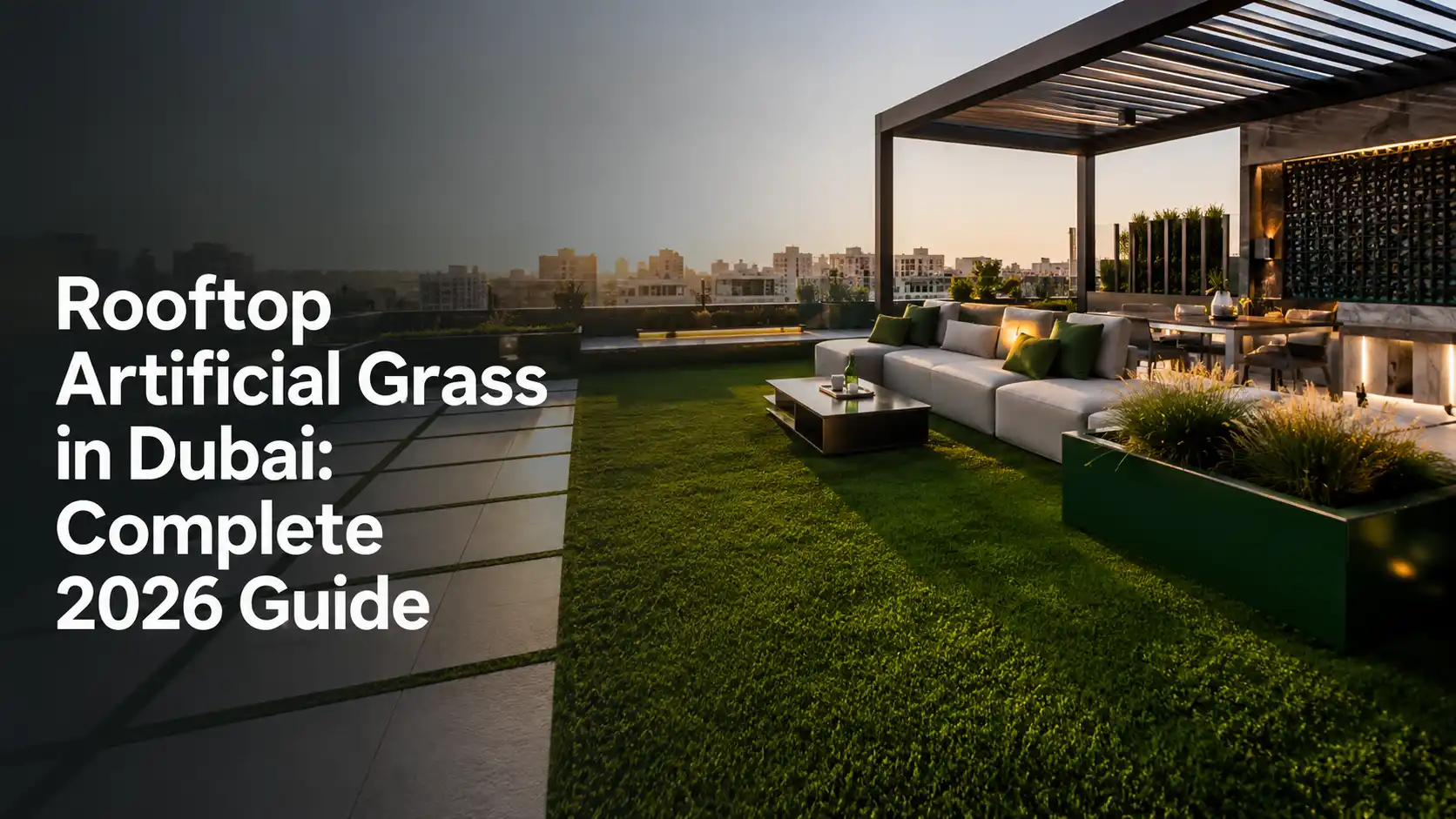
Most Dubai rooftops are the largest unused room in the property, sitting empty all year and hosting nothing but an air conditioning unit.
Rooftop artificial grass in Dubai is a practical way to convert that space, but only if the roof itself is ready for it. A correctly built rooftop turf system adds roughly 3 to 5 kg per square metre, sits on a drainage cell layer that protects your waterproof membrane, and costs between AED 45 and AED 90 per square metre supplied and installed. This guide covers how to check whether your roof qualifies, the weight and drainage rules, how hot the surface gets in a UAE summer, and what maintenance really involves. If you already know your roof is suitable and just want a price, go straight to our rooftop artificial grass installation in Dubai service page.
Key Takeaways
- A rooftop turf system weighs about 3 to 5 kg per square metre, so most standard Dubai roof slabs need no reinforcement.
- The drainage cell layer is what protects your waterproof membrane. Turf glued flat to a roof deck is the most common rooftop failure in the UAE.
- Fibre shape and infill affect surface temperature more than colour. Shade over the area is the only thing that meaningfully cools it at midday.
- Expect AED 45 to AED 90 per square metre supplied and installed, so a 50 square metre terrace lands between AED 2,250 and AED 4,500.
Is Your Dubai Rooftop Suitable for Artificial Grass?
Almost every flat or gently sloping Dubai rooftop is suitable, provided the slab is structurally sound, the waterproof membrane is intact, and water has somewhere to go. Suitability is decided by the condition of the roof, not its size. Balconies of 2 square metres and hotel terraces of several hundred use the same underlying system. Run through this checklist before you request a quote.
- Check the surface condition. Cracked screed, spalling concrete, lifting tiles or soft patches must be repaired first. You will not want to lift the grass again in two years to fix them.
- Confirm the waterproof membrane is intact. If your roof already leaks into the room below, artificial grass will hide the problem, not solve it.
- Find the drainage points. The finished turf level must never sit above an outlet or scupper. If your roof ponds water after rain today, it will pond under turf tomorrow.
- Note every fixed obstacle. HVAC condensers, water tanks, planters, pergola posts and service hatches all need the turf cut around them, and hatches must stay accessible.
- Consider crew access. A villa roof with a staircase is straightforward. A high floor balcony reached only by a service lift changes how the material is cut and carried, so mention it when you enquire.
How Much Weight Does Rooftop Artificial Grass Add per Square Metre?
A complete rooftop artificial grass system adds approximately 3 to 5 kg per square metre without infill, rising to roughly 8 to 12 kg per square metre once silica sand infill is applied. A planted lawn with growing medium is well over 50 kg per square metre saturated. That difference is the entire reason turf works on roofs and real grass does not. Standard Dubai residential slabs are designed for occupancy loads far above these figures, so the vast majority of rooftop turf installations need no structural reinforcement. What matters more is that the load is spread evenly, which a continuous drainage cell layer does by design.
| Rooftop surface | Approximate weight per sqm | Notes for Dubai roofs |
| Artificial grass, drainage cells, no infill | 3 to 5 kg | Lightest usable option. Suits balconies and older slabs. |
| Artificial grass with silica sand infill | 8 to 12 kg | Adds stability and heat management on high traffic areas. |
| Timber or WPC decking on pedestals | 25 to 40 kg | Heavier, hotter underfoot, higher cost per sqm. |
| Porcelain pavers on pedestals | 45 to 70 kg | Needs a structural check on most residential roofs. |
| Soil based planted lawn | 50 kg and above when saturated | Not viable on standard Dubai rooftops. |
Figures are typical system weights for planning. Exact values depend on pile height, backing type and infill rate, and any project on an older or unusual structure should be confirmed by the building consultant. The build up at ground level is completely different, and our wider guide to artificial grass in Dubai covers the sub base options used at grade.
Will Artificial Grass Damage Your Roof Waterproofing?
Correctly installed rooftop artificial grass protects the waterproof membrane rather than damaging it. The turf and drainage layer shield the membrane from direct UV and from the daily temperature swing that ages bitumen and polymer membranes faster than anything else. Damage comes from the installation method, not the material. Three mistakes account for most rooftop failures we are called to inspect in Dubai.
Gluing turf directly to the roof deck. Adhesive across the full membrane traps moisture, blocks lateral drainage and makes future repair destructive. Rooftop turf should sit on a drainage cell layer and be fixed at the perimeter and seams only.
Fixing through the membrane. Nails, screws or anchors driven into the slab puncture the layer keeping water out of the room below. Every penetration is a future leak. Use adhesive to the perimeter upstand, weighted battens or purpose made edge trims instead.
Blocking the outlets. Turf laid over a roof drain, or drainage cells finishing proud of the scupper, guarantees standing water. Outlets stay visible and serviceable, with the turf cut around them in a neat collar.
Ask any installer directly whether they will penetrate the membrane. The answer tells you a great deal about the quality of the work.
How the Drainage Layer Actually Works
The drainage cell layer creates a continuous air gap between the roof deck and the turf backing. Water passes through the permeable backing, drops into that void, then runs across the roof fall to the existing outlet. Nothing sits against the membrane, and nothing relies on the turf to move water sideways. This matters more in Dubai than people assume, because rainfall arrives in intense bursts and air conditioning condensate runs all summer.
Two details are worth insisting on. The turf backing must be fully permeable across the whole sheet, not perforated at intervals. And the drainage cells must reach the outlet rather than stopping short at a decorative border, which creates a dam. Get it wrong and you see the same symptoms as at ground level, namely pooling, odour and mould in the backing, as set out in our guide to artificial grass drainage issues.
How Hot Does Rooftop Turf Get in Dubai Summer?
Artificial grass on an exposed Dubai rooftop does get hot in direct midday sun, and no turf product prevents that entirely. Any surface in full sun at 45°C ambient is uncomfortable to touch at midday, including bare concrete, tiles and decking. What you can control is how fast the surface sheds heat. Three specification choices make a measurable difference: fibre shape, since C shaped and W shaped fibres stand upright and dissipate heat faster than flat or round monofilament; pile height, where 25mm to 35mm cools quicker and 35mm to 50mm looks lusher; and silica sand infill, which stabilises fibres and buffers temperature at the cost of extra weight.
| Specification choice | Best for | Effect on heat and use |
| 25mm to 35mm pile, C shaped fibre, with infill | Play terraces, high traffic roofs | Cools fastest, most durable underfoot, easiest to clean |
| 35mm to 50mm pile, W shaped fibre, with infill | Villa roof lounges and sky gardens | Lush appearance, good heat dissipation, slightly softer |
| Long pile, flat fibre, no infill | Decorative areas with light use only | Retains heat longer and flattens under repeated traffic |
The genuine fix for daytime use is shade, not turf selection. A tensioned canopy over the seating zone drops the surface temperature beneath it sharply and makes the roof usable through the afternoon rather than only after sunset. It is the most common upgrade our rooftop clients ask for after living with the space for a summer. Our shade nets in Dubai service covers the fabric options, and our guide to installing shade nets in Dubai explains GSM, colour and fixing before you commit to a design.
For the numbers on how turf compares to other surfaces in the heat, see our article on whether artificial grass gets hot.
Send us a photo of your rooftop on WhatsApp and we will come back with a fixed price, usually the same day. No site visit needed for an initial quote, and no obligation. WhatsApp +971 54 228 7784.
Wind, Shamal Dust and High Rise Balconies
Height changes the brief. Wind speed rises sharply with elevation, and a high floor balcony in Dubai Marina or Business Bay sees loads a ground level garden never experiences. Loose laid turf that is perfectly stable in a villa courtyard can lift at the edges on the twentieth floor.
Edge restraint is the answer. On elevated installations the perimeter is bonded to the upstand or secured with weighted trims along every free edge, and seams are joined continuously rather than spot fixed. Corners get particular attention, because uplift always starts at a corner.
Shamal winds bring the second issue, fine sand. Dust settles into the pile and over a season dulls the colour and stiffens the fibres if never rinsed out. A monthly rinse and brush handles it completely. Finally, keep the finished turf level below the parapet drainage slots, and never build it up so far that a balcony balustrade becomes easier to climb.
Rooftop Artificial Grass Cost and Maintenance in Dubai
Rooftop artificial grass in Dubai generally costs between AED 45 and AED 90 per square metre supplied and installed, covering the drainage layer, turf, adhesives, seam joining, edge finishing and power brushing. Rooftop rates sit above ground level rates because of the drainage cells, the cutting around obstacles and the access involved. A 50 square metre villa roof terrace typically lands between AED 2,250 and AED 4,500, and a 15 square metre apartment balcony between AED 675 and AED 1,350. Prices vary by size and site condition, so treat these as planning ranges and get a quote for your actual roof. For a breakdown across all area types, see our guide to artificial grass installation cost in Dubai.
Maintenance is light. Brush the pile monthly to lift the fibres and clear dust, rinse after a sandstorm, and keep debris away from the drain collar. Pet owners should add a diluted disinfectant rinse monthly. There is no watering, mowing, feeding or gardener contract, which is where the running cost saving comes from. Our artificial grass cleaning routine for UAE conditions covers stain and odour treatment step by step. Well specified rooftop turf holds its colour for roughly 8 to 12 years under sustained UAE sun, which is why UV stabilised fibre is worth paying for on a roof more than anywhere else.
Frequently Asked Questions
Do I need permission for rooftop artificial grass in Dubai?
For a private villa roof, generally no, because nothing structural changes and no penetrations are made. Apartment owners and tenants should check with building management or the owners association first, as many towers set rules on balcony finishes, weight and external appearance. Hotel and commercial roofs need facilities team sign off.
How long does a rooftop installation take?
Most Dubai rooftop and balcony projects finish within 24 to 48 hours of confirmation, and a typical villa terrace is done in a single working day. Larger commercial roofs and those needing surface repair take longer. The space is usable immediately after handover, with no curing period.
Will rooftop artificial grass fade in Dubai sun?
Quality UV stabilised turf holds its colour for around 8 to 12 years under direct rooftop sun. Budget turf without UV stabilisation can visibly fade in a single UAE summer, which is the most common reason cheap rooftop installations disappoint. Ask for the UV stability rating of the specific product.
Can I put furniture, a pergola or planters on rooftop turf?
Yes. Standard outdoor furniture, planters and lightweight pergolas sit on rooftop turf without issue. Use wide feet or protective pads under heavy items so point loads do not permanently flatten the pile. Anything needing a fixed anchor into the slab must be planned before the turf is laid.
Is artificial grass safe for children on a rooftop terrace?
The turf is non toxic, lead free and antimicrobial, and gives a softer, better grip surface than bare concrete or tiles. The rooftop specific points are balustrade height, keeping the finished level well below the railing, and providing shade for daytime use.
Turning Your Roof Into Usable Space
Rooftop artificial grass works in Dubai because it solves the three problems that stop anything else working up there: weight, drainage and heat exposure. Get the roof checked, insist on a drainage cell layer, specify UV stabilised fibre, and add shade over the area you plan to sit in.
HomeGeek has installed rooftop and balcony turf across Dubai since 2015, from Palm Jumeirah villas to Marina balconies. Send a photo of your roof to WhatsApp on +971 54 228 7784 for a fixed price, or book a free site visit through our contact page. We are at Dragon Mart 01, International City, Dubai, open daily 10am to 10pm.



One Response