Step onto a synthetic lawn at two in the afternoon and you learn something fast. Some turf is comfortable. Some are close to unbearable. The gap between the two is not luck. It comes down to the yarn, the color, the infill, and how the lawn was installed.
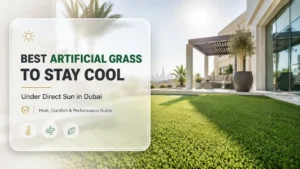
Artificial grass that stays cool under direct sun uses heat reflective yarn, a lighter green tone, and a sand based infill. A breathable backing completes the setup by letting heat escape from below. Standard turf can reach 66 to 77 degrees Celsius in peak UAE sun. Cooling grade artificial grass in Dubai typically runs 10 to 17 degrees Celsius cooler in the same garden. This guide explains why turf overheats, what actually lowers the surface temperature, and how to keep your lawn comfortable through a Dubai summer.
Key Takeaways
Synthetic fiber holds no moisture, so it cannot cool itself the way living grass does. Heat reflective yarn and lighter green tones make the biggest difference at the material level. Silica sand infill runs cooler than crumb rubber and sheds that heat faster once shade arrives. A quick rinse with a hose drops the surface temperature within minutes. Shade and smart timing solve the rest without any extra spend.
Why Does Artificial Grass Get So Hot in Dubai
Artificial grass gets hot because synthetic fibers absorb sunlight and hold onto it. Living grass avoids this through transpiration, where moisture rises through the blades and evaporates, carrying heat away as it goes. Turf has no such mechanism. On a day when the air sits near 32 degrees Celsius, a standard lawn surface can climb to between 54 and 71 degrees Celsius. Push that air temperature into Dubai summer territory and the surface goes higher still.
The contrast with a living lawn is stark. Natural grass on a hot day usually measures 24 to 35 degrees Celsius and rarely passes 38. Synthetic turf can run roughly 19 to 31 degrees Celsius warmer than the natural grass beside it.
Three material choices drive most of that heat. Fiber density comes first, because thick, untreated yarn absorbs far more solar energy than a thinner reflective blend. Color comes second, since deep, saturated greens soak up light the way a dark dashboard does. Infill comes third, and it is the one buyers forget. Crumb rubber stores heat and gives it back slowly, so the lawn stays warm long after the sun has moved off it.
The Dubai Factor Nobody Mentions
Most turf guides are written for climates that never see a Gulf July. They miss what matters most here, which is reflected heat. A lawn set between two villa walls, or beside a glass facade, or bordered by pale paving, receives sunlight twice. Once directly, and again as it bounces off the surfaces around it.
This is why two identical lawns nearby can feel completely different underfoot. An open garden with soil borders behaves one way. A courtyard boxed in by walls and tiled paths behaves another, and a lawn has to be specified for the second case rather than the first.
What Makes Artificial Grass Stay Cool
Cooling comes from several small decisions stacked together, not one headline feature. The most effective is yarn treatment. Manufacturers blend reflective pigments into the fiber so it bounces solar energy away instead of storing it. This happens at production, so it cannot be added later to a lawn you already own.
Yarn shape supports the same goal. Fibers with a C shaped or W shaped cross section leave more room for air to move between blades. Warm air rises out of the pile instead of sitting trapped at the base. Flat yarn packs tighter and holds that heat close to your feet.
Color choice is the easiest win and the one most people get wrong. Lighter, more natural greens with a subtle brown thatch reflect noticeably more sunlight than a deep, uniform emerald. The darker product almost always looks better in a showroom photograph, and almost always feels worse in August.
Infill deserves more attention than it usually gets. Silica sand and coated sand absorb less heat than crumb rubber and release it faster once the sun moves off. Some specialist infills go further by holding moisture from rain or a light watering, then releasing it slowly as temperatures climb. This borrows the cooling trick that living grass uses and can pull the surface down by as much as 17 to 28 degrees Celsius in testing.
Backing construction finishes the job. A breathable backing with proper drainage lets heat escape from underneath rather than building against the base layer. On a rooftop or any tiled surface, this decides whether a lawn recovers overnight or stays warm into the evening.
Cooling Technology Comparison
| Feature | Standard Turf | Cooling Grade Turf |
| Yarn treatment | Untreated fiber | Reflective pigment blended into yarn |
| Yarn cross section | Flat, straight cut | C shaped or W shaped for airflow |
| Peak surface temperature | 66 to 77C | 49 to 63C |
| Infill | Crumb rubber | Silica sand or coated sand |
| Color tone | Dark, saturated green | Lighter green with natural thatch |
| Recovery after sun moves off | Slow, stays warm | Cools quickly in shade |
| Best fit | Shaded corners, low use areas | Open gardens and family lawns |
Choosing the Right Turf for Your Garden
Start by mapping the sun rather than the square meters. Walk the space at midday and again at four in the afternoon, and note which sections sit in full sun and which pick up shade from a wall or a tree. A garden that only catches morning light does not need the highest specification product. A west facing lawn that takes the full afternoon does.
Pile height matters more than most buyers expect. Somewhere between 30 and 40 millimeters is the sweet spot for UAE gardens. It holds its shape under heat, resists matting, and still lets air move through the blades. Very long pile turf looks luxurious in a brochure but traps warm air near the base, which quietly undoes the benefit of good yarn. Density works the same way. A denser lawn wears better, but only stays cool if the yarn profile still allows airflow.
When you compare quotes, ask three specific questions. Is the reflective treatment in the yarn or only a surface coating? Which infill is included as standard, and what does an upgrade involve? Does the backing have drainage holes suited to the surface you are covering? Any supplier who cannot answer all three is selling a product built for somewhere else, and that is the single biggest reason a new lawn disappoints people in its first summer.
Ground shape changes the answer too. Water and warm air both collect at the low point of a garden, so artificial grass on a slope has to be laid over a graded, compacted base or the bottom of the lawn will run warmer and damper than the top.
Send a photo of your garden on WhatsApp and we will come back with a free, no obligation quote. Most quotes go out within minutes.
How to Keep Your Lawn Cooler Day to Day
Even a well chosen lawn benefits from a few summer habits. A light rinse with a garden hose cools the surface within minutes, because the evaporating water carries heat away exactly as sweat does on skin. On the hottest days the effect holds for roughly 20 to 45 minutes, which is usually enough for children or pets to enjoy the space. Keep it light. Soaking the lawn repeatedly wastes water and does nothing extra.
Shade is the strongest long term answer. A pergola, a shade sail, a mature tree, or even a large parasol removes hours of direct exposure every single day, and that adds up faster than any product upgrade. Aim it at the part of the lawn people actually use.
Timing costs nothing. Early morning and the hour after sunset are comfortable on almost any turf. Many families find that shifting garden time by two hours solves the problem entirely.
Installation quality quietly affects all of this. Heat and moisture pool under a lawn that sits on loose or badly graded ground, which is why the artificial grass installation process puts compaction and drainage ahead of everything else. Turf laid straight onto unprepared ground runs warmer and recovers slower, no matter which product sits on top.
Maintenance That Protects the Cooling Effect
Cooling performance fades on a lawn that is neglected. Dust settles into the infill and coats the fibers, and that layer blocks both the reflective pigment and the infill’s ability to hold moisture. In a city where fine dust is constant, this happens faster than people expect. A regular brush against the pile direction lifts the blades and redistributes the infill so both keep working. Dust is also the reason cleaning artificial grass in the UAE is a monthly summer job rather than an annual one, since a single rinse restores far more of the reflective surface than most owners expect.
One warning is worth repeating. Strong solvent based cleaners can strip reflective treatments over time, leaving a lawn that absorbs more heat than it did when new. Warm water with a mild detergent handles almost everything a UAE garden throws at turf.
Frequently Asked Questions: Artificial Grass to Stay Cool
Does artificial grass get hotter than real grass in Dubai?
Yes, and by a wide margin. Living grass releases moisture through its blades, which cools the surface naturally. Synthetic fiber cannot do this. Natural grass typically sits between 24 and 35 degrees Celsius on a hot day, while standard turf in direct UAE sun can reach 66 to 77 degrees Celsius. Cooling grade products narrow that gap considerably.
What is the coolest color of artificial grass?
Lighter greens with a natural brown thatch run cooler than deep, saturated shades. Darker colors absorb more solar energy, in the same way a dark car interior heats faster than a pale one. If heat is your main concern, resist the most vivid green on the sample board even though it photographs beautifully.
Is sand or rubber infill cooler for artificial grass?
Sand and coated sand stay cooler than crumb rubber. Rubber granules store heat and give it back slowly, keeping the lawn warm well into the evening. Sand based infill absorbs less to begin with and cools quickly once shade arrives, which is why hot climate specifications almost always use it.
Can I install cooling artificial grass on a rooftop or balcony?
Yes, and these surfaces benefit most from it. Tiles and concrete store heat and radiate it back into the turf from below, so a backing with proper drainage holes and airflow matters more here than in a soil based garden. Rooftop and balcony jobs should always be specified with this in mind.
How long does the cooling effect from watering artificial grass last?
Around 20 to 45 minutes on the hottest days, and longer when conditions are milder. Treat it as a quick fix before the children go out rather than a standing solution. Pairing it with reflective yarn, sand infill, and shade gives a lawn that stays usable without constant watering.
Is artificial grass safe for kids to play on in Dubai summer?
Cooling grade turf with reflective yarn and sand infill is far safer underfoot than a standard product, particularly when it is shaded and rinsed before use. Heat is only half the question though, because artificial grass for kids play areas is specified for impact absorption and a softer pile as well as a lower surface temperature.
Does cooling artificial grass cost more than standard turf?
It usually carries a modest premium, since the reflective yarn treatment and the sand infill both add to production cost. Set against the total supply and installation price the difference is generally small, and it buys back a garden you can use through the hottest months. Ask for an itemised quote so you can compare both options directly.
Get a Cooler Lawn Installed Across Dubai
Choosing artificial grass that stays cool comes down to three things. Pick reflective yarn in a lighter tone, insist on sand based infill, and make sure the base and backing let heat escape. Add shade and a quick rinse on the worst days and even a Dubai July becomes manageable.
HomeGeek supplies and installs artificial grass across Dubai, Sharjah, Ajman, and Abu Dhabi, with real samples you can hold in your own garden light before deciding. Send a photo of your space on WhatsApp for a free, no obligation quote, or book a free site visit and compare cooling grade turf against a standard lawn side by side.
Author: HomeGeek install team Schema to apply: Article, FAQPage, Service, BreadcrumbList