Most Dubai balconies arrive with the same finish. Plain builder tile, hot by noon, dusty by Thursday, and used mainly for the drying rack.
Artificial grass suits most Dubai apartment balconies better than tiles. It is softer underfoot, quicker to fit, and easy to lift when a lease ends. Tiles and decking hold the advantage on furniture stability and a more premium finish. How you use the space, and whether you rent, decide the winner.
We fit both artificial grass across Dubai and hard outdoor flooring for balconies and terraces, so this comparison reflects real jobs rather than a brochure. It covers heat, drainage, cleaning, lifespan and price drivers.
Key Takeaways
- Artificial grass is the softer surface and the friendlier one for children, bare feet and lounging.
- Tiles and decking stay flatter under furniture, so a dining balcony usually favours them.
- Both surfaces get hot in direct afternoon sun. Shade is what actually cools a balcony.
- Grass is easier to reverse at the end of a tenancy, because it can be laid loose with no adhesive.
- Many balconies work best with both, using grass for the sitting zone and tile for the table.
Artificial Grass vs Tiles for Balconies at a Glance
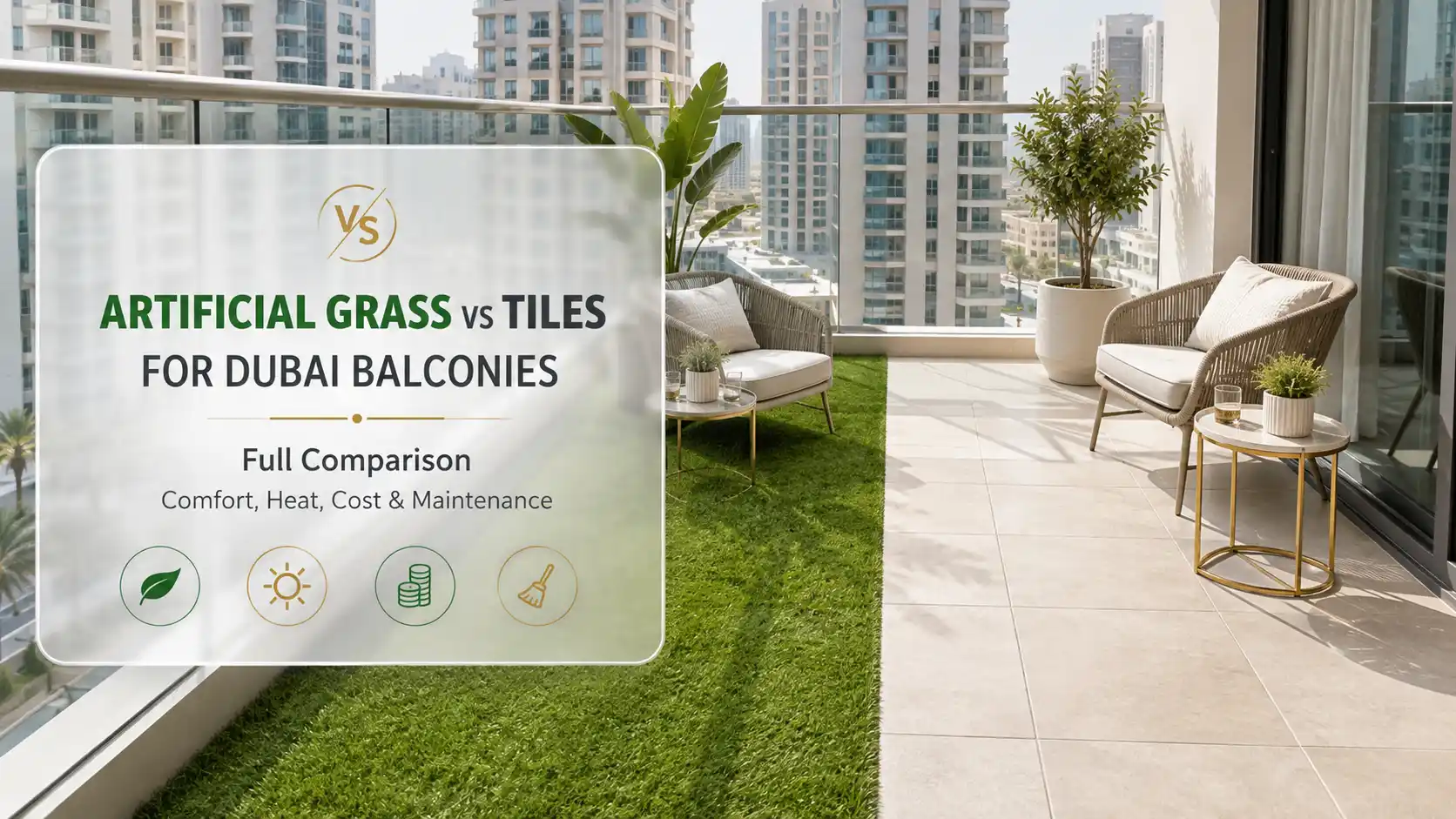
Neither surface wins every category. Artificial grass leads to comfort, speed and reversibility. Tiles and decking lead on rigidity and the look of a finished terrace. The table below sets them side by side on the six factors that matter most in a Dubai apartment.
| Factor | Artificial grass | Outdoor tiles and decking |
| Comfort underfoot | Soft and cushioned, good barefoot | Firm and solid, harder underfoot |
| Heat in direct sun | Gets hot, shade is the only real fix | Gets hot, shade is the only real fix |
| Drainage | Free draining with permeable backing | Drains through joints and gaps |
| Furniture stability | Legs can sink slightly into the pile | Stable and level under table legs |
| Renter friendly | Yes, when laid loose with no adhesive | Depends on the fixing method used |
| Cleaning routine | Brush and rinse | Sweep and wash |
The short verdict
Choose artificial grass if the balcony is for relaxing, for children, or for making a bare space feel green. Choose tiles or decking if it is mainly for dining or heavy planters. Hard flooring also reads better as an extension of the living room.
Not sure which suits your space? Send a photo on WhatsApp to +971 50 574 1557 and our team will tell you, along with a fixed price.
Comfort and Heat Underfoot on a Dubai Balcony
Artificial grass is noticeably softer than tile, and that is the main reason people choose it. Tile is rigid. That is what you want under a dining chair, and what you do not want under a bare foot in August.
How the two surfaces feel
Grass fibres compress under your weight and spring back, which produces a cushioned step. Tile and composite decking stay firm, so they feel solid and stable but never soft.
The trade goes both ways. A chair leg on grass can sink a few millimetres into the pile and rock slightly, where on tile it sits level. If a table lives on the balcony year round, the pile beneath it will flatten and stay flattened.
Heat is a shade problem, not a material problem
Every surface in Dubai afternoon sun gets hot, and neither of these is an exception. Synthetic fibres absorb solar energy and hold it rather than releasing it, which is why artificial grass gets hot in direct sun in the same way stone and porcelain do. On a balcony with walls reflecting heat back, both can stay warm into the evening.
So treat this as a shade question, not a material question. A canopy or parasol changes how usable a balcony feels far more than the flooring choice does. Anyone promising you a surface that stays cool through a Dubai afternoon is overselling.
Drainage on a Balcony With No Floor Drain
This is where most balcony problems start. Plenty of Dubai apartment balconies have no floor drain at all, so water leaves through a small gap at the parapet or simply evaporates.
How each surface handles water
Artificial grass with fully permeable backing lets water pass straight through the sheet. It then runs across the existing tile, following the fall the builder gave you, and exits at the parapet gap. Backing that is perforated only at intervals is the usual reason a balcony holds damp.
Tiles and interlocking deck tiles drain through the joints between units instead. Raised pedestal systems create an open cavity, which drains very well but adds height at the door threshold.
The mistake that causes damp on both
Sealing the surface tight against all four walls traps water, whichever material you choose. That turns the balcony into a shallow tray with no outlet, so leave the drainage gap at the parapet clear.
If your balcony pools water after rain today, it will pool under a new floor tomorrow. Fix that first. Our guide to laying artificial grass on balconies and terraces sets out the correct build up. Tile follows the same rule of never fighting the existing slope.
Cleaning, Maintenance and How Each Surface Ages
Artificial grass needs brushing and tile needs washing. Neither is demanding, but they fail in different ways, and that matters more than the weekly effort.
The routine each one asks for
Grass wants a stiff brush every month or so. Brushing lifts the fibres, clears shamal dust and keeps the surface even. Spills and pet mess come out with mild soap and water, a routine we set out step by step in our guide to cleaning artificial grass in the UAE.
Tile is a sweep and a wash. Dust sits on the surface rather than in it, so a broom does most of the work. Grout lines and joints are the weak point, because they collect dust and stain over time.
How they age differently
Grass ages by flattening. Traffic lanes and furniture spots lose their spring first, and the pile there will not fully recover. Colour also fades gradually under constant UV, which is why the manufacturer warranty is worth reading before you buy.
Tile ages by cracking, lifting or staining, though replacing one cracked unit is simpler than replacing a whole sheet of grass. Timber decking asks the most of you, since it needs periodic oiling to stay presentable.
Lifespan depends far more on product quality, sun exposure and installation than on the material category, a point we break down in our guide to artificial grass lifespan and warranty in the UAE. Ask any supplier for the written warranty rather than a spoken figure.
Price Drivers, Renters and Building Approval
Cost on a balcony is driven by size, material grade, the amount of cutting and the fixing method. Balconies are small, so most projects sit at the lower end of any flooring job.
What actually moves the price
Four things push a balcony quote up. An irregular shape means more cutting and more waste. A seam means more labour and a more skilled fit. Bonded or trimmed edges cost more than a loose lay. And premium materials, whether a thick grass pile or a porcelain paver, cost more than entry level product.
Grass is usually cheaper to supply and fit on a small balcony, because it arrives as one sheet and needs no jointing. Porcelain and composite systems involve more units and more setting out. Our page on artificial grass installation costs explains the variables, and the same logic drives our tile flooring installation service.
If you rent, reversibility decides it
A tenant should think about the handover before the look. Grass laid loose, with no adhesive and no wall fixings, lifts out in minutes and leaves the original floor untouched. Interlocking deck tiles that clip together are also removable. Anything bedded in adhesive or screwed down is not.
Many Dubai towers set rules on balcony finishes, weight and external appearance. Ask your building management or owners association in writing before you order. Say clearly that the installation is removable with no penetrations, because that gets signed off quickly.
Which One Fits Your Balcony?
Match the surface to how you use the space rather than to a photograph you liked.
- A lounging balcony with two chairs and a coffee table suits artificial grass. Softness is the point, and light furniture will not crush the pile.
- A dining or barbecue balcony suits tile or decking. Table legs stay level and food spills wipe off a hard surface.
- A balcony used by children or pets suits artificial grass, because it is the more forgiving surface for knees and paws.
- A narrow utility balcony with a washing machine or drying rack suits tile. Appliance feet need a firm, level base.
- A wider terrace often suits both, with grass along the sitting end and tile under the table.
That last option is more common than people expect. Splitting a terrace into zones costs little more than a single surface and solves the furniture problem cleanly.
Frequently Asked Questions
Is artificial grass cheaper than tiles for a Dubai balcony?
On a small balcony, artificial grass is usually the cheaper option to supply and install. It arrives as one sheet and takes less labour than laying tiles or boards. Price still varies with the pile, the shape of the balcony and whether the edges are bonded. Ask for a fixed quote based on your measurements.
Which is better for a rented apartment, grass or tiles?
Artificial grass is the safer choice for tenants. Laid loose, with no adhesive and no wall fixings, it lifts out in minutes and leaves the original floor as you found it. Interlocking deck tiles are also removable. Check your tenancy contract and building rules in writing before ordering either one.
Does artificial grass or tile flooring get hotter on a balcony?
Both get hot in direct Dubai sun, and neither stays cool without help. Synthetic fibres absorb and hold solar energy, while stone and porcelain do the same. On an enclosed balcony, reflected heat from the walls keeps both surfaces warm into the evening. Shade is the only reliable fix, so plan a canopy or parasol for a west facing balcony.
Can you install both artificial grass and tiles on the same balcony?
Yes, and on a wider terrace it is often the best result. A common layout runs grass across the sitting area and keeps a tiled strip for the dining table. Furniture stays level while the rest stays soft. Zoning also makes a narrow balcony read longer, because the change of surface breaks up the run.
Which lasts longer on a Dubai balcony, artificial grass or outdoor tiles?
Lifespan depends more on product quality, sun exposure and installation than on the material itself. Grass ages by flattening in traffic lanes and fading under UV. Tile ages by cracking, lifting or staining at the joints. Ask for the written manufacturer warranty on whichever product you choose.
Does artificial grass trap water on a balcony with no drain?
Not when it is specified correctly. Fully permeable backing lets water pass straight through. A thin drainage layer lifts the sheet off the tile so water runs to the parapet gap. Problems come from backing perforated only at intervals, or from sealing the grass tight against all four walls.
Is artificial grass comfortable and safe for children on a balcony?
Artificial grass is the softer of the two surfaces. That makes it more forgiving for knees and bare feet than tile or composite decking. For a play area, a shock pad can be added underneath for extra cushioning. Balcony safety still depends mainly on railing height and supervision.
Making the Call on Your Balcony
Artificial grass wins on comfort, speed and reversibility, which suits most Dubai apartment balconies used for relaxing. Tiles and decking win on stability and a harder wearing finish, which suits dining balconies and utility spaces. On a wider terrace, using both is often the smartest answer.
HomeGeek has supplied and installed balcony surfaces across Dubai since 2015. Send a photo to WhatsApp on +971 50 574 1557 for a fixed price, or book a free measurement with our team. We are at Dragon Mart 01, International City, Dubai, open daily 10am to 10pm.