
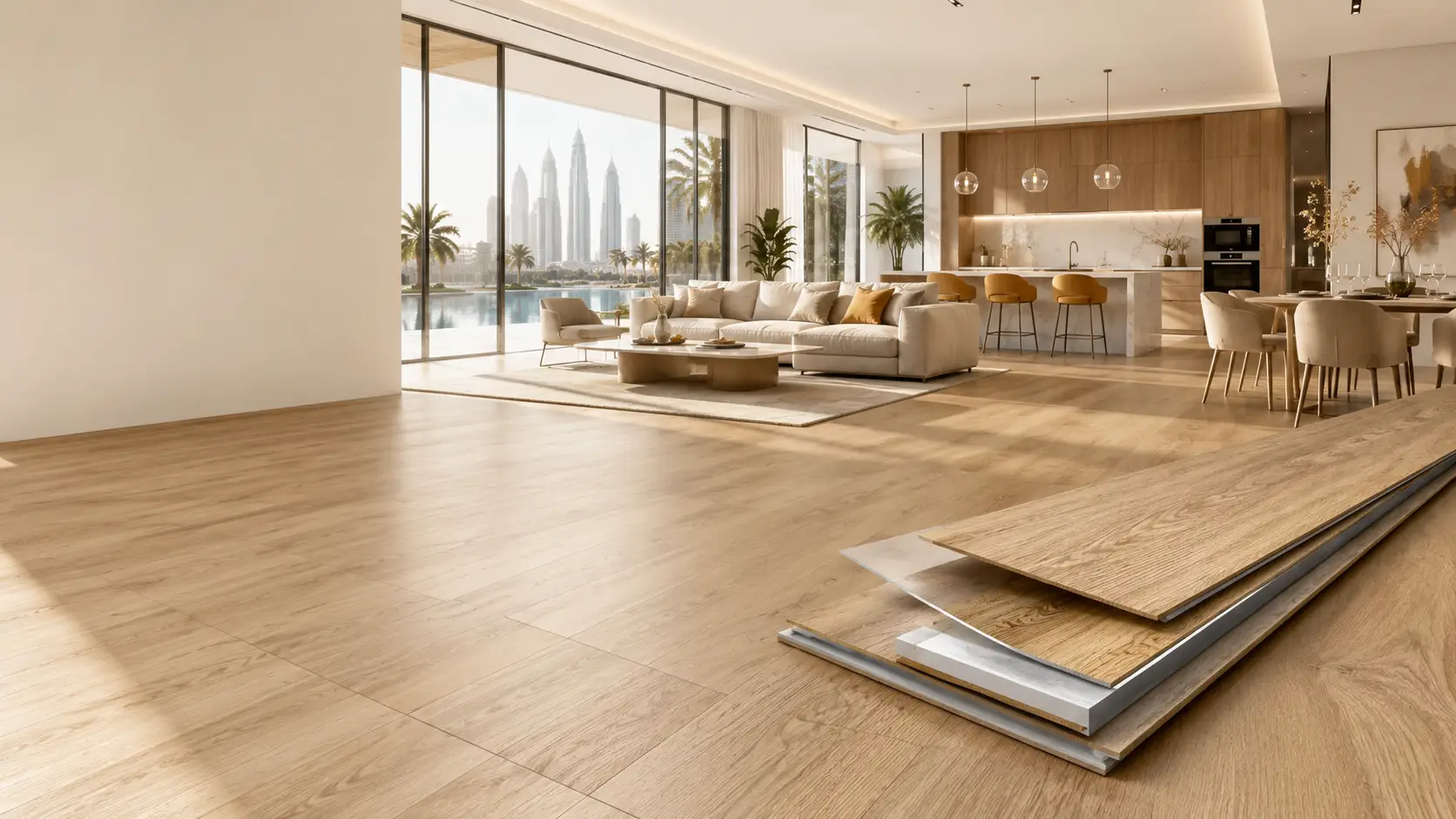
Vinyl flooring is a resilient floor covering made mainly from polyvinyl chloride, or PVC. Makers produce it as planks, tiles and sheets. Each type has protective layers that shape how it looks, lasts and installs.
Vinyl flooring is not just one product. Flexible vinyl, luxury vinyl tile, sheet vinyl, SPC and WPC all differ in how they are built. Some are thin and bend with the subfloor. Others use a rigid core that stays flat.
Before you choose a product, it helps to know a few basics:
- What the flooring is made of
- How the layers fit together
- Which core type it uses
- How well it resists wear and water
- How it gets installed
- Whether it suits the local climate
Vinyl Flooring Definition and Main Characteristics
Vinyl flooring belongs to a group called resilient flooring. These floors flex a little under foot traffic, then spring back into shape. This is different from a hard surface such as ceramic tile or stone.
Most vinyl flooring shares a few common traits:
- A PVC-based structure
- Printed designs that copy wood or stone
- Plank, tile or sheet formats
- A water-resistant surface
- Several installation options
- Separate grades for homes and businesses
These traits vary from product to product. A thin glue-down tile behaves nothing like a thick, rigid plank or commercial sheet vinyl.
| Attribute | Common vinyl flooring characteristic |
| Main material | PVC |
| Main formats | Planks, tiles and sheets |
| Surface visuals | Wood, stone, concrete and decorative patterns |
| Core options | Flexible, SPC and WPC |
| Installation | Click, glue-down, loose lay and sheet installation |
To pick the right product, it helps to know what goes into it.
Vinyl Flooring Materials and PVC Composition
Vinyl flooring is not solid PVC. Most products mix PVC resin with mineral fillers, pigments and other additives, topped with a protective layer. Each part does its own job, and different layers can use different formulas.
PVC Resin, Mineral Fillers and Performance Additives
PVC resin forms the main body of the plank. Mineral fillers add weight and stiffness, and calcium carbonate is a common filler in SPC cores. Pigments give the floor its color. Stabilizers help it hold up over time, and a surface treatment improves cleaning and wear.
The exact mix changes between brands, and even between product lines from the same brand. Always ask for real manufacturer data instead of assuming every SPC or LVT product uses the same recipe.
Recycled Content and Alternative Material Inputs
Some vinyl flooring includes recycled PVC, factory offcuts, mineral content or wood-based material. Recycled content means where the raw material came from. Recyclability means what can happen to the product later. Take-back programs are formal systems that collect and reuse old flooring.
Be careful with broad claims like “green flooring” or “chemical-free.” These terms need real proof from the manufacturer.
Vinyl Flooring Layers and Their Functions
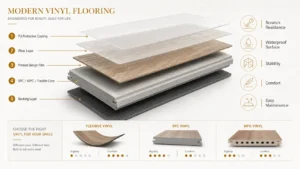
Most vinyl flooring is built in layers, a type called heterogeneous vinyl. Homogeneous vinyl uses a more uniform structure all the way through. Picture a cross-section of a plank. A clear coating sits on top. Below it comes a wear layer, then a printed design film, and finally the structural core and backing.
Polyurethane Coating and Surface Protection
The top coating, often polyurethane, helps with stain resistance, easy cleaning and light scratch protection. This coating is a finish, not the main body of the plank. It affects how easy the floor is to clean, its shine, and how visible scratches are. No vinyl surface is truly scratch-proof, since all coatings wear down over time.
Wear Layer Thickness and Traffic Resistance
Just under the coating sits the wear layer, a clear PVC layer that protects the printed design below. A thicker wear layer usually resists surface wear for longer, but thickness alone does not decide quality. Check the surface coating, the traffic rating and the warranty terms too. A bedroom floor and a busy shop floor need different wear layers.
Design Film, Printing and Embossed Texture
Below the wear layer sits the design film, which creates the wood, stone or decorative look of the floor. Makers use sharp printing and varied patterns to avoid an obvious repeat. Many products also use registered embossing, a texture that lines up with the print. These visual features affect looks only, apart from strength and durability.
Core Layer, Reinforcement and Backing
The core gives the plank its shape and structure. A flexible PVC core stays thin and follows the subfloor closely. A rigid SPC core uses a dense, mineral-filled mix that resists bending. A WPC core uses a foamed structure that adds cushioning. Some products also add fiberglass, a balance layer or acoustic backing. Backing can reduce impact sound, though the full floor system decides the final test result.
Types of Vinyl Flooring: LVP, LVT, Sheet Vinyl and VCT
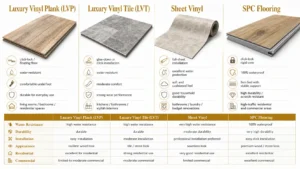
Vinyl flooring comes in several formats. The format changes how many seams a floor has and how it gets installed.
Luxury Vinyl Plank Flooring
Luxury vinyl plank, or LVP, comes in plank shapes that usually look like timber. It can be flexible and glued down, rigid and click together, or simply laid loose. LVP suits living rooms, bedrooms, offices, hotels and shops.
Luxury Vinyl Tile Flooring
Luxury vinyl tile, or LVT, comes in tile shapes that often copy stone, concrete, terrazzo or ceramic. LVT works well for modular layouts, borders and mixed patterns. It is a shape and a product family, not one fixed installation method. Always check how a specific product is built.
Sheet Vinyl Flooring
Sheet vinyl comes in wide rolls, not separate pieces. Large sheets mean fewer seams than planks or tiles. This is one reason sheet vinyl is common in hospitals, schools, kitchens and clinics. Some sheet systems use heat-welded seams, built specifically for that kind of joint.
Homogeneous Vinyl and Heterogeneous Vinyl
Homogeneous vinyl has one uniform structure all the way through. Heterogeneous vinyl is built from separate surface, design and structural layers. Homogeneous flooring often goes into heavy-duty commercial spaces, while heterogeneous flooring usually offers more design choices.
Vinyl Composition Tile
Vinyl composition tile, or VCT, is a commercial tile made from vinyl binders, mineral fillers and pigments. Unlike LVT, it usually needs glue-down installation plus regular polishing to keep its look.
Vinyl Flooring Core Types: Flexible Vinyl, SPC and WPC
The core of a vinyl floor affects stiffness, stability, comfort underfoot and installation. The table below compares the three main core types.
| Attribute | Flexible vinyl | SPC vinyl | WPC vinyl |
| Core structure | Flexible PVC-based layer | Dense mineral-filled rigid core | Foamed composite core |
| Underfoot feel | Thin and resilient | Firm | Softer |
| Common installation | Glue-down | Click-lock | Click-lock |
| Subfloor sensitivity | Higher | Moderate | Moderate |
| Main advantage | Low profile | Rigidity and stability | Comfort and sound absorption |
Flexible Vinyl Flooring Construction
Flexible vinyl follows the shape of the subfloor closely. It suits low-profile jobs, glue-down systems and detailed layouts. It also works well for commercial fit-outs, since a single plank can be replaced later. Because it is thin, it needs a smooth, well-prepared subfloor.
SPC Vinyl Flooring Construction
SPC stands for stone plastic composite, or stone polymer composite, depending on the manufacturer. It uses a dense, mineral-filled core that supports stability and click-lock installation. Check the underfoot firmness, product weight and locking-system quality. SPC is stable, but it can still expand and shrink with temperature changes.
WPC Vinyl Flooring Construction
WPC stands for wood plastic composite, or wood polymer composite. It usually uses a foamed core that adds comfort underfoot and helps absorb sound. Check the thickness, density and dent resistance for each product, since these details vary between brands.
Vinyl Flooring Water Resistance, Durability and Lifespan
Many vinyl products resist water well, but a water-resistant material does not make a whole room waterproof. Water can still get through gaps at the edges, damaged joints and spots where pipes pass through the floor.
Water Resistance in Kitchens and Bathrooms
Water-resistant material is not a waterproof product claim, subfloor waterproofing, or a fully sealed system. Before fitting vinyl in a kitchen or bathroom, check its wet-area approval, edge treatment and joint rules. Not every vinyl floor suits every bathroom, so confirm this for your exact product.
Wear Resistance and Long-Term Durability
Durability depends on matching the product to how it will be used. Long-term wear is shaped by the wear layer, surface coating and traffic rating. Rolling loads, furniture movement, grit, cleaning chemicals, sunlight and installation quality matter too.
Expected Vinyl Flooring Lifespan
There is no single lifespan that fits every vinyl floor. Quality, traffic, maintenance, installation and local conditions all play a part. For a realistic estimate, check the manufacturer’s warranty. Look at results from similar past projects instead of relying on one generic number.
Vinyl Flooring Performance in Dubai and the UAE
Vinyl flooring can perform well in Dubai and across the UAE. It works best when matched to local sunlight, heat, moisture and building conditions.
Direct Sunlight and High Floor Temperatures
Sunlight through large windows can push floor temperatures well above room temperature. Too much heat can move the planks and stress the joints. It can also weaken the adhesive, discolor the surface and strain the locking system. It may also affect the warranty, so check the maximum floor surface temperature the product allows before buying.
Concrete Subfloor Moisture
Concrete slabs in the UAE can hold or pass through moisture. Check moisture levels, slab flatness, cracks and surface contamination, since leveling compounds and adhesive choice matter too. Test results must stay within the limits set by both the flooring maker and the adhesive maker.
Air Conditioning and Temperature Changes
An occupied home, an empty property and a site mid-installation can all sit at different temperatures. Confirm the acclimation and installation temperature rules for your product before work starts.
Sand, Grit and Entrance Protection
Sand and fine grit can slowly wear down a vinyl surface. Good entrance mats and regular dry cleaning help reduce this.
Vinyl Flooring Installation Methods
There are four main ways to install vinyl flooring: click-lock, glue-down, loose lay, and sheet installation. The best method depends on the product design, room size, traffic and subfloor condition.
Click-Lock Vinyl Flooring Installation
Click-lock planks connect at the edges to form a floating floor that is not glued to the subfloor. Installers need to plan for expansion gaps, transition strips near fixed cabinetry, underlay compatibility and doorway separation.
Glue-Down Vinyl Flooring Installation
Glue-down vinyl bonds straight to the prepared subfloor. This method suits low floor heights, heavy commercial traffic, rolling loads and detailed pattern layouts. Success depends on staying within moisture limits, picking the right adhesive, and preparing a smooth subfloor.
Loose-Lay and Sheet Vinyl Installation
Loose-lay flooring stays in place through its own weight, backing friction, or fixing at the room’s edges. Sheet vinyl needs careful seam planning and edge treatment. Large projects, staircases and warranty-covered work should go to a professional installer.
Vinyl Flooring vs Laminate, Hardwood and Tile
The table below offers a general comparison. See our separate guides for deeper coverage of vinyl versus laminate, tile and hardwood.
| Flooring material | Water behavior | Underfoot feel | Main strength | Main limitation |
| Vinyl flooring | Depends on the product | Resilient to firm | Design and installation flexibility | Heat and substrate requirements |
| Laminate flooring | Depends on core and joints | Firm | Strong wood visuals | Some products are water-sensitive |
| Hardwood flooring | Sensitive to moisture | Warm and solid | Natural look and can be refinished | Moves with humidity |
| Ceramic tile | Resists water well | Hard | Resists heat and wear | Hard, unforgiving surface |
| Natural stone | Depends on the stone type | Hard and cool | Natural variation in look | Heavy, needs a strong subfloor |
No single material wins every case. The right choice depends on the room, the budget, and how the space gets used.
Vinyl Flooring Quality Indicators
Total thickness alone does not prove a floor is high quality. A few specific checks give a clearer picture.
Wear Layer and Surface Specification
Before you buy, check the wear-layer thickness, surface coating and traffic rating. Also check stain resistance, scratch resistance and warranty conditions.
Core Density and Locking-System Quality
A rigid core should stay straight and stable over time. Inspect the plank edges and locking profiles yourself, and ask for a physical sample rather than trusting marketing photos.
Acoustic, Fire, Slip and Emissions Testing
Any performance claim should come with a test report or a real certificate. Acoustic tests measure impact sound reduction. Fire tests classify reaction to fire. Slip tests measure surface grip, and emissions tests check the floor’s effect on indoor air. Certificates apply to the exact product tested, not to the whole brand.
Vinyl Flooring Selection by Room and Project Type
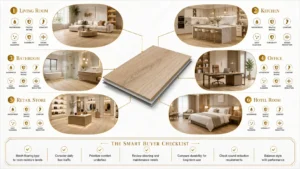
The table below is a starting point for narrowing your options.
| Application | Main selection criteria |
| Apartment living room | Acoustic performance, sunlight and furniture loads |
| Villa kitchen | Water exposure, cleaning and appliance loads |
| Bathroom | Wet-area approval, sealing and waterproof substrate |
| Office | Chair-castor resistance, sound and repair access |
| Retail store | Traffic class, entrance grit and rolling loads |
| Hotel room | Acoustic backing, comfort and replacement process |
| Clinic | Hygiene, seam treatment and chemical resistance |
This table helps with a first shortlist. It does not replace a site visit or a proper technical spec for your project.
Vinyl Flooring Buying Checklist
- Confirm the exact vinyl flooring type.
- Check the wear-layer thickness.
- Review the core construction.
- Confirm the installation method.
- Verify the traffic classification.
- Check water-exposure limits.
- Review temperature restrictions.
- Verify acoustic requirements.
- Request emissions certificates.
- Check fire and slip classifications.
- Read the installation instructions.
- Review warranty exclusions.
- Inspect a physical sample.
- Confirm subfloor suitability.
- Request a project-specific quotation.
Request product samples, technical datasheets, and a project quotation before you choose. Your supplier should check the subfloor, traffic level and sunlight exposure before work begins.
Frequently Asked Questions About Vinyl Flooring
Is vinyl flooring made from plastic?
Most vinyl flooring uses PVC, a synthetic polymer. Products may also contain mineral fillers, pigments, reinforcement layers and protective coatings.
Is vinyl flooring the same as linoleum?
No. Vinyl flooring mainly uses PVC. Linoleum is traditionally made from linseed oil, wood flour, cork dust, pigments and backing material.
Is vinyl flooring waterproof?
Many vinyl products resist water well. Joints, edges, and the condition of the subfloor affect how the full installation performs.
Can vinyl flooring be installed over tiles?
Yes, in many cases, if the existing tiles are stable, clean, dry and level. Deep grout lines may need smoothing first.
Is SPC a type of vinyl flooring?
Yes. SPC is a rigid-core vinyl flooring type. It has a dense, mineral-filled composite core with vinyl surface layers on top.
Is vinyl flooring suitable for Dubai?
Yes, when the product is chosen with sunlight, surface heat, concrete moisture, air conditioning and correct installation in mind.






One Response