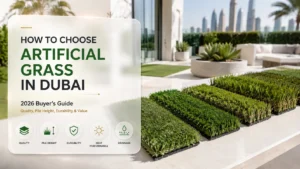
Most people choose artificial grass by touching a few samples and picking the one that feels nicest. That is the last step in the process, not the first.
Knowing how to choose artificial grass comes down to six decisions, taken in order. Define how the space will be used, then measure the area and set the specification. Read each quote line by line, compare them fairly, and check the warranty and the installer before you sign anything.
Taking them in that order is what stops you paying for the wrong lawn. This guide walks through each step, and it is written for villa and apartment owners in Dubai, Sharjah, Ajman and Abu Dhabi. If you are gathering quotes for artificial grass installation in Dubai, it shows you what to look at before you commit.
Key Takeaways
- Your space sets the specification, and the specification sets the budget. Work in that order, not backwards.
- Measure the area yourself before you contact a supplier. It changes every conversation that follows.
- A quote is only comparable once you know what sits inside it and what has been left out.
- The lowest rate per square metre is often the most expensive job once ground work is added back in.
- A warranty is only worth something if it names the product, the exclusions, the length of cover and who handles a claim.
How to Choose Artificial Grass: The Six Step Sequence
Choosing artificial grass is a chain of six decisions, and each one narrows the next. The space you are covering sets the performance you need, and that performance sets a realistic budget. The budget then shapes your shortlist of suppliers.
Most buyers start at the far end, by comparing prices, and try to work backwards from there. That is what produces a lawn that looks wrong within two summers. A price you like is not a specification, and two suppliers can quote the same figure for very different work. You have no way to tell them apart until you know what you asked for.
The table below sets out the order and what each step decides for you.
| Step | What you decide | What it locks in |
| 1. Define the space | How the area will be used day to day | The performance the surface has to deliver |
| 2. Measure | Area, shape and access | Material volume, waste and seam count |
| 3. Set the specification | The written product requirement | What every supplier is being asked to price |
| 4. Read the quote | What sits inside the scope | Where hidden costs are waiting |
| 5. Compare quotes | Like for like value | Which quote is genuinely cheaper |
| 6. Check warranty and installer | Who stands behind the work | Your protection after the crew leaves |
Every step below assumes one team supplies the grass and fits it, which is how most residential projects in the UAE are handled.
Step 1: Define How the Space Will Actually Be Used
Start with use, not with looks. How a space is used decides everything that follows, because it sets the traffic the surface takes, how it needs to drain, and how often you will clean it. Answer these six questions before you look at a single sample.
- How much foot traffic will the area take in a normal week?
- Will anyone walk on it barefoot, and at what time of day?
- Will children or pets use it regularly?
- How many hours of direct sun does it get, and does anything shade it?
- Does it sit over soil, or over tiles, concrete or a roof deck?
- Is it visible from inside the house, or is it a working surface?
Those answers are the brief you hand to a supplier. Without them, you are asking someone to guess.
Ground level gardens and lawns
A garden laid over soil gives you the most freedom, because the base can be built up and graded properly. Appearance usually leads here, but traffic still matters. A front lawn that everyone walks across is a different job from a decorative side strip.
If you have not settled the question of whether to switch at all, the trade offs between artificial grass and natural grass in UAE conditions are worth reading before you spend time on quotes.
Balconies, rooftops and terraces
Hard surfaces change the problem completely. There is no sub base to drain into, so water has to pass through the grass and reach an existing floor drain. Weight limits often apply on upper floors, and wind lift becomes a real issue on exposed roofs. This is why rooftop artificial grass is treated as its own category rather than a garden lawn moved upstairs.
Play areas and pet zones
Safety and cleaning take priority over appearance. Falls, spills and daily washing all shape what the surface has to cope with. Grass specified as artificial grass for a kids play area is built around those demands, including what goes underneath it.
Step 2: Measure Your Area Before You Call Anyone
Measure the space yourself before you contact a single supplier. A measured plan turns a vague enquiry into a specific one, and it lets you sense check every quote you get back. You do not need to be exact, only close enough to spot a supplier who is guessing at your numbers.
Here is how to do it in about fifteen minutes.
- Sketch the area on paper. It does not have to be neat, but keep the proportions roughly right.
- For a rectangle, measure the length and the width, then multiply them.
- For an L shape or any irregular area, split it into rectangles, measure each one, then add the results together.
- For curved beds and borders, measure the widest point in both directions and treat it as a rectangle. You will over estimate slightly, which is what you want.
- Note the narrowest point of access, such as a gate, a stairwell or a lift. Access decides how the material reaches the site.
- Write down anything fixed that the grass has to fit around, including trees, planters, drains, manholes and irrigation heads.
Two things surprise most first time buyers. The first is waste, because grass is cut from a roll and an awkward shape leaves offcuts that you still pay for.
The second is seams. Roll width is fixed, so a wide area needs joins, and where those joins fall changes how the finished lawn looks. Ask any supplier to show you on your sketch where the seams will run.
A measured plan also makes the first conversation faster. Send us a photo of your garden, balcony or roof terrace on WhatsApp at +971 50 574 1557 with your rough measurements, and we will tell you what the space needs and send a free quote with no obligation.
Step 3: Set the Specification Before You Set the Budget
Set the specification from how the space is used, then find out what it costs. Do it the other way round and the budget picks the product. The product then has to cope with a job it was never built for. That is the most common reason a lawn fails early.
A specification does not need to be technical. It needs to be written down. Every supplier should be quoting against the same version of it. Ask for these to be stated in writing on the quote:
- The product name and the manufacturer
- Pile height in millimetres
- Density or stitch rate
- Face weight in grams per square metre
- The backing type and how it drains
- The UV stabilisation method, and whether a colour warranty comes with it
- The infill type, if infill is being used
You do not need to know the ideal value for each one. You do need to notice when one is missing. A supplier who will not put face weight and UV stabilisation in writing is telling you something useful.
If those terms mean nothing to you yet, that is normal. You can still hold a supplier to them. Our breakdown of the types of artificial grass and what pile height, density and face weight actually tell you shows how to read each figure off a spec sheet.
One local factor is worth adding. Fine sand and dust settle into any outdoor surface here, and they work down into the pile. A lawn you plan to rinse often behaves differently from one you will mostly just look at. Mention that when you brief a supplier.
Sun exposure is the other thing that separates a good spec from a poor one. It is why imported turf built for mild climates struggles here. Which specs hold up matters far more than which sample feels softest, and the best artificial grass for UAE heat and UV comes down to a small number of them.
Step 4: How to Read an Artificial Grass Quote
Read a quote as a scope of work, not as a price. The number at the bottom only means something once you know which tasks are included and which have been quietly left out. Most disputes on these projects come from work that was never in the quote in the first place.
Go through every quote against this list.
| Line item | What to look for | What it means if missing |
| Supply or supply and fit | Stated clearly at the top | You may be quoted for material only |
| Site clearance | Removal of old grass, soil, tiles or gravel | Clearance gets added as an extra later |
| Base preparation | Excavation, levelling, compaction, base material | The most common gap in a cheap quote |
| Drainage | Falls, permeable layers, connection to a drain | Water pooling becomes your problem |
| Material quantity | Square metres including waste allowance | Under ordering causes delays mid job |
| Seaming and joins | Where seams fall and how they are fixed | Visible or lifting joins later |
| Edging and fixing | Perimeter treatment and how edges are secured | Edges lift, especially on roofs and in wind |
| Infill | Type and quantity, or a clear note that none is used | An extra charge on the day |
| Waste removal | Who takes away the debris | You dispose of it yourself |
| Rate basis | Per square metre or per square foot | Two quotes that look similar are not |
| VAT | Stated separately or included | The final figure moves |
| Timeline | Start date and working days on site | No basis to hold anyone to a date |
Base preparation is the line that deserves the most attention. It is invisible once the job is finished, which is exactly why it is the easiest place to cut corners. Knowing what a proper artificial grass installation process involves makes it far harder for a thin scope to slip past you.
Step 5: Comparing Two Quotes Fairly
Two quotes are only comparable when they describe the same job. Before you compare totals, line them up. Put both on the same rate basis. Add any excluded work back into the cheaper one. Then check that both are pricing the same specification.
Do that and the picture often flips. A quote that looked lower per square metre can end up higher once clearance, ground work and edging are added back. A quote that looked expensive can turn out to be the only complete one. It helps to know roughly what an artificial grass installation costs in Dubai before you start, so you can tell a keen rate from an incomplete one.
When a quote sits far below everything else, it is usually down to one of a few things.
- Base preparation reduced or removed
- A lighter product than the one you specified
- No written UV or colour warranty behind the material
- Waste allowance not included, so the shortfall is billed later
- Site clearance and disposal excluded
- The rate quoted per square foot while others quoted per square metre
None of those make a supplier dishonest. Some are simply a different scope. The point is that you cannot see any of them from the total alone. That is why scope has to be compared before price.
Cost is also where people ask whether to buy the material and lay it themselves. That is a real option for small, simple, flat areas. It is a poor one for anything else. Our comparison of DIY and professional artificial grass installation sets out where the line falls.
Step 6: Check the Warranty and the Installer
A warranty is only as good as the document behind it. The words “UV protected” on a brochure are marketing. What you want is a written warranty that names four things: the exact product, the length of cover, the exclusions, and who you contact if something goes wrong.
There are usually two warranties on a job, and they are not the same.
The manufacturer warranty covers the grass itself, normally against colour loss and fibre breakdown. It comes from the factory, so it applies whoever fits it. Ask which manufacturer. Then ask to see the document, not a claim about it.
The workmanship warranty covers the installation: seams, edges, levels and drainage. This one comes from your installer. It is only as good as the company giving it. A long warranty from a business with no traceable history is not worth much.
Then look at the installer. Ask whether their own crew does the work, or whether it is subcontracted. That decides who you deal with if there is a problem. Ask to see finished projects rather than catalogue photographs. Our completed work samples show real installations across Dubai, and that is the kind of proof worth asking any company for.
Questions to Ask Before You Commit
Take this list to every supplier you speak to, and ask the same questions each time so you can set the answers side by side. How quickly and clearly a supplier replies tells you as much as the answer itself does, and a good one will put it in writing.
About the product
- Which manufacturer makes this grass, and what is the product name?
- Can I see the specification sheet?
- How is the UV stabilisation applied, and is there a written colour warranty?
- Can I take a sample home and look at it in daylight?
About the scope
- Is this quote supply only, or supply and installation?
- What base preparation is included, and to what depth?
- Is site clearance and waste removal included?
- Where will the seams fall on my layout?
- How much waste allowance is built into the quantity?
About what happens next
- Does your own team install, or do you use subcontractors?
- What does the workmanship warranty cover, and for how long?
- What routine care does this product need?
That last question matters more than people expect. Upkeep here is simple but not zero, and knowing how to clean artificial grass in UAE conditions before you buy helps you pick a product you will actually look after.
Choosing Artificial Grass for a Rented Property
Renting changes the decision, and a lot of buyers in Dubai and Sharjah are renting. The main question is whether the work is permanent. That decides whether you need the landlord’s written approval before anything starts.
Work laid over soil normally involves digging, so treat it as a permanent change and get approval in writing first. Work laid over existing tiles or a balcony floor can often be done without cutting or drilling, which is far easier to agree and far easier to undo.
Three points are worth settling before you order.
- Ask the supplier whether the area can be fitted without permanent fixing into the existing floor.
- Confirm what happens at the end of the tenancy, and who is expected to remove it.
- Keep the quote and the specification, because a landlord may want to see what was installed.
If the tenancy is short, a lighter job over a hard surface usually makes more sense than full ground work you cannot take with you.
Frequently Asked Questions
How do I choose artificial grass without seeing it in person first?
Start with the written specification, not the look. Ask for the product name, pile height, density, face weight, backing type and UV stabilisation in writing, then ask for physical samples before you confirm. Photos are unreliable for colour, and no screen shows you how a blade springs back when you press it. Most UAE suppliers will bring samples to your home free.
What should I ask a supplier before buying artificial grass?
Ask which manufacturer makes the product and whether there is a written colour warranty. Ask what ground work is included, where the seams will fall, and whether their own team installs or subcontracts. Then ask what the workmanship warranty covers and for how long. Suppliers who answer these in writing are usually the ones worth shortlisting.
How do I compare two artificial grass quotes fairly?
Put both quotes on the same basis before you look at the totals. Check whether each is per square metre or per square foot, whether site clearance and base preparation are included, and whether both are pricing the same specification. Then add any missing work back into the cheaper quote. Once the scopes match, the real difference in value shows up.
Do I need to measure my garden before requesting a quote?
You do not have to, but it helps a great deal. A rough measurement lets you sense check the quantities on every quote, and it shows you which supplier is estimating rather than measuring. Sketch the area, split it into rectangles, and note the access points. Any professional supplier will still measure on site before they confirm.
Can I install artificial grass in a rented villa or apartment in Dubai?
Usually yes, though it depends on the property and the tenancy agreement. Work over existing tiles or a balcony floor can often be done without permanent fixing, which most landlords accept more readily. Anything that involves digging counts as a permanent change, so get written approval first and agree who removes it at the end of the tenancy.
How long does it take from choosing the grass to installation day?
For a straightforward residential area, a site visit to a finished lawn usually runs within a few days, depending on material availability and how much ground work is needed. Larger areas, rooftops with tight access, and jobs that need drainage correction take longer. Ask for the working days on site to be stated on the quote.
What is usually missing from a cheap artificial grass quote?
Base preparation is the most common omission, followed by site clearance, waste removal and edging. Some quotes also leave out the waste allowance, so the shortfall gets billed once the job has started. A quote far below the others is rarely the same job at a better price. It is normally a smaller scope.
What is the most common mistake people make when choosing artificial grass?
Choosing the product before defining the space. Buyers often pick the sample that feels softest in a showroom, then find it does not suit the traffic, the drainage or the way the area is really used. Decide how the space will be used first, write the specification from that, and only then compare products and prices.
Making the Decision
Choosing artificial grass is less about finding the best product and more about working in the right order. Define the space, measure it, and write the specification before you look at any total. Read and compare every quote against that specification, not against each other. The warranty and the installer are what protect the decision once the work is done.
If you want a second opinion on a quote you have already received, or you would rather start from a measured plan, send a photo of your space on WhatsApp to +971 50 574 1557 and we will come back with a free, no obligation quote. You can also reach the team through our contact page, daily from 10am to 10pm.