Most Dubai villas have a slab that nobody uses. A back courtyard, a side return, a patch of concrete beside the parking. It stays grey, it bakes all afternoon, and it collects dust.
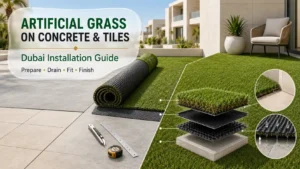
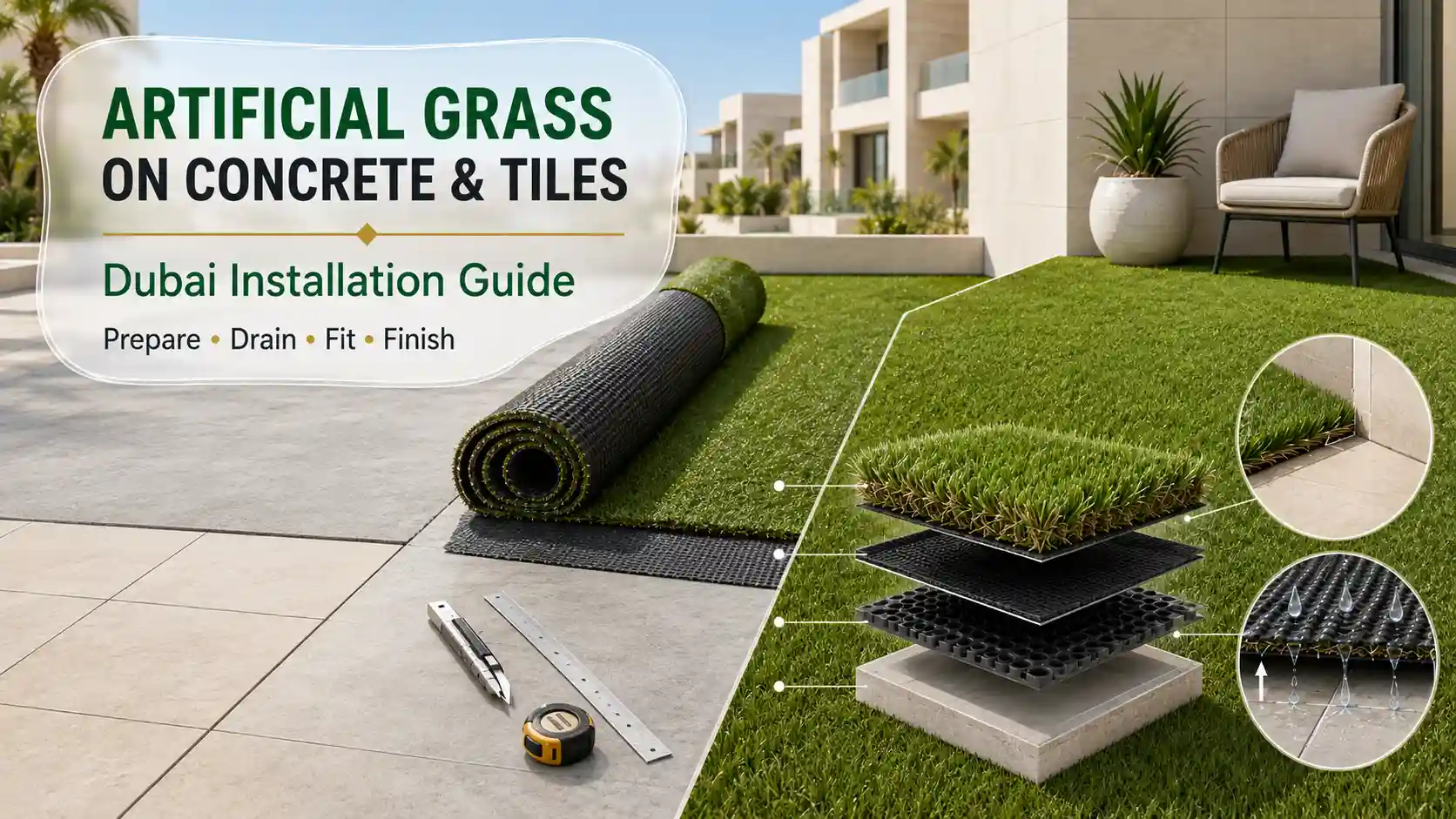
Yes, artificial grass can be laid directly on concrete or tiles with no need to break out the existing surface. The slab must be sound, reasonably level and free draining. A permeable foam underlay goes between the two, and the grass is fixed by adhesive, tape or weight rather than nails.
This guide covers hard surfaces at villas and townhouses: patios, courtyards, driveways, garage floors, screed and tiled outdoor areas.
Key Takeaways
- A sound slab does not need breaking out, because artificial grass goes straight over concrete, screed or tile.
- Permeable foam underlay is the critical layer. It levels the surface, carries water sideways and hides whatever sits beneath.
- Ponding water is the only real dealbreaker, so correct the fall or drill drainage holes before anything else happens.
- Nails cannot be used on a slab, which leaves adhesive, tape, edging trim or weight as the fixing options.
- Adhesive on glazed tile is hard to reverse, so choose a loose lay if you want the original floor back.
Can You Lay Artificial Grass on Concrete or Tiles?
Yes, and on most villa hard surfaces it is the faster of the two installation methods. There is no excavation and no sub base to compact. A courtyard that would occupy two days as a full artificial grass installation in Dubai is often completed in a single day.
When the slab is fine as it is
A sound slab needs very little preparation. Most Dubai villa patios fall into this category, because they were originally laid on a proper base with a slight fall built in. That is exactly what a covering surface requires.
If the concrete feels stable underfoot, drains after a hose down and carries no cracks wider than a pencil, it is ready for underlay. Tiles behave in the same way when they are firmly bedded. Nothing has to come up, and the original floor stays protected underneath.
When the slab needs work first
Three problems will stop the job before it starts. Water that pools and remains there after an hour. Cracks that have moved, so one side now sits higher than the other. Tiles that rock or sound hollow when you tap them.
None of these are fatal, but every one has to be corrected before anything is laid over the top. Surface repair is normal work on a hard surface installation. A free site visit is usually enough to tell you which category your slab belongs to.
The 10-Minute Slab Readiness Test
You can assess a slab yourself before speaking to any supplier, using nothing more than a hose and a straight edge. The table below covers the same seven checks our installers run on a first visit.
| Check | What to do | Pass | Fail action |
|---|---|---|---|
| Ponding | Hose the slab, wait one hour | Water has drained or spread thin | Mark the low spots for drainage holes |
| Cracks | Look for cracks wider than 5mm | Hairline marks only | Fill and level before laying |
| Level | Rest a long straight edge across it | Gaps under the edge below 5mm | Use a self levelling compound |
| Loose tiles | Tap each tile and listen | Solid sound throughout | Re bed or replace the loose ones |
| Joints and gaps | Measure any gap between slabs | Under 25mm | Fill with quick drying cement |
| Door threshold | Measure clearance under the door | Above the finished grass height | Drop to a thinner underlay |
| Expansion joints | Find the movement joints | Present and clear | Never bridge them rigidly |
Two of these checks matter considerably more than the others. A gap wider than 25mm between slabs will sag beneath the sheet within weeks. A tile that rocks today will eventually crack the surface above it. Everything else on the list is cosmetic by comparison, so it affects looks rather than durability.
What Goes Between the Grass and the Concrete
A permeable foam underlay is the layer that makes any hard surface installation work properly. It is not padding for comfort alone, and skipping it remains the most common mistake on a concrete job.
Why underlay is not optional here
On soil, the compacted aggregate used in the standard ground installation process performs three separate jobs at once. It levels the ground, it carries water away and it softens the surface underfoot. Concrete achieves none of them, so the underlay has to take over all three.
Foam also hides whatever sits beneath it. Every dip, trowel mark and grout line telegraphs through a low pile sheet laid straight onto a hard floor. Thickness is what prevents that, so a thin sheet of foam will not rescue a badly finished slab.
Choosing a thickness
| Thickness | Best for | Trade-off |
|---|---|---|
| 5mm | Tight door thresholds, indoor concrete | Least cushioning, hides little |
| 10mm | Most villa patios and courtyards | The standard domestic balance |
| 15mm | Areas used barefoot or by children | Adds height at thresholds and edges |
| 20mm | Play zones and gym areas over a slab | Softest, dearest, needs trimmed edges |
Ten millimetres suits most Dubai villa patios [CONFIRM against HomeGeek house standard]. Whatever thickness you choose, the foam must have drainage holes moulded through it. Closed cell foam with no perforation turns the underlay into a sealed tray. That is the opposite of what a slab actually needs. Fifteen millimetres and above does the same work as the shock pad build up used under play surfaces, where impact absorption matters more than appearance.
Drainage on a Surface That Cannot Absorb Water
Concrete absorbs nothing, so every drop of water landing on your slab has to travel sideways to an edge or a drain. Get that wrong and the damp simply sits against the backing of the grass.
Where the water actually comes from in Dubai
Rain is the smallest input here. Air conditioning condensate drips onto the same spot every day throughout summer. Irrigation overspray from a neighbouring bed lands along the slab edge. Wash down water from cleaning has nowhere to escape on a courtyard with no outlet.
Shamal dust makes the situation worse over time. Fine sand washes down into the underlay and gradually blocks the drainage holes, which explains why a slab that drained well in its first year can hold water by the third.
The hose test and drilling holes
Pour a bucket of water onto the slab and watch what happens next. Steady movement toward an edge or a drain means the existing fall is doing its job. A puddle still sitting there an hour later means that spot needs a hole.
Drainage holes are 16mm across, drilled every half metre to a metre through the low areas, then backfilled with pea gravel so they do not clog. That repair costs far less than relaying concrete. Standing water is also responsible for most drainage issues that appear after installation, because damp weakens the adhesive bond long before anything begins to smell.
Not sure whether your slab drains? Send a photo on WhatsApp to +971 50 574 1557 and our team will tell you what it needs, along with a fixed price.
Laying Artificial Grass on Tiles: What Changes
Tiles follow the same installation method as concrete, with three additional things to watch.
Grout lines show through. A tiled floor carries a grid of lines every 300mm or 600mm, and a low pile sheet picks up every single one of them once the light rakes across the surface. Ten millimetres of foam or more is the answer here, rather than a thicker grass.
Glazed tile becomes slippery when wet. The underlay sits on a surface with almost no grip, so an unrestrained edge can slide underfoot. Perimeter fixing therefore matters considerably more on tile than it does on rough concrete.
Adhesive does not come off cleanly. This is the honest part, because grass bonded straight onto a glazed tile face can lift the glaze or leave residue that needs grinding away. If you might want the tile back, insist on a loose lay or a trim fixed edge instead.
The same principles apply higher up, although artificial grass on balconies and terraces adds the additional problem of no floor drain at all.
How the Grass Is Fixed Down Without Nails
You cannot pin grass to a slab. Nails and staples need something to grip. Driving anything into concrete also risks damaging the waterproof layer below it. Four other methods replace them.
Loose lay relies on the weight of the sheet and a tight cut against the walls. It suits sheltered courtyards and anyone who wants the surface to stay reversible.
Perimeter adhesive bonds only the outer band to the slab, so it resists wind while leaving the centre of the sheet completely free to drain.
Double sided tape joins seams and holds edges where glue is unwanted, which makes it the lighter option for indoor concrete.
Aluminium or composite trim frames the edge mechanically. It gives the cleanest finish against a wall or a step, and it takes the most abuse.
Wind decides which method you actually need. An enclosed villa courtyard can be loose laid safely, while an exposed corner or an upper terrace needs restrained edges to stop them lifting.
Concrete Build-Up Compared With a Ground Installation
The two jobs share only their top layer, because everything underneath it differs completely.
| Layer | On soil | On concrete or tile |
|---|---|---|
| Base | Excavate 75 to 100mm, lay and compact aggregate | Existing slab, cleaned and repaired |
| Levelling | Sharp sand blinding, screeded flat | Self levelling compound where needed |
| Drainage | Water soaks through the base into soil | Water runs sideways, holes drilled if flat |
| Cushion layer | Optional shock pad | Permeable foam underlay, always |
| Fixing | Pins and staples into the base | Adhesive, tape, trim or weight |
| Timeline | Longer, digging and compaction | Shorter, no excavation |
Cost follows the same split, so on a slab you save the digging and the stone, then spend part of that back on underlay and edge fixing. Surface repair is the item that moves a hard surface quote most. Two courtyards of the same size can price very differently. The wider picture on artificial grass installation cost covers the remaining variables.
Frequently Asked Questions
Can you lay artificial grass directly on concrete without underlay?
You can, although it rarely produces a good result. Without foam the grass feels hard underfoot, every dip and trowel mark in the slab shows through the pile, and water loses its route to travel sideways. A permeable underlay resolves all three problems for a small share of the total cost.
Do you need to drill drainage holes in a concrete patio?
Only where water actually pools. Hose the slab down and wait an hour, because water running to an edge or a drain means the existing fall is doing its job. If a puddle remains, drill 16mm holes through that area at half metre to one metre spacing and backfill them with pea gravel.
Will grout lines or slab joints show through the grass?
They will if the underlay is too thin or missing entirely. Grout lines sit in a regular grid, so the eye picks them up immediately once light rakes across the surface. Ten millimetres of permeable foam hides normal grout lines, though gaps wider than 25mm between slabs need filling first because foam alone will sag into them.
How is artificial grass fixed to concrete without nails?
Through adhesive, tape, trim or weight. Perimeter adhesive bonds the outer band only and leaves the centre free to drain, while double sided tape holds seams and edges without a permanent bond. Aluminium trim frames the edge mechanically, and a sheltered courtyard can often be loose laid with no fixing at all.
Can artificial grass be removed from concrete or tiles later?
That depends entirely on the fixing method used. Loose laid grass lifts out in minutes and leaves the surface untouched, while tape usually peels away leaving some residue behind. Adhesive bonded to a glazed tile face is the problem case, because removing it can pull the glaze or leave a film requiring grinding.
Does artificial grass on concrete get hotter than grass on soil?
Slightly, yes. Soil beneath a lawn draws a little heat away, whereas a slab absorbs sun throughout the day and holds onto it, although the foam underlay helps by breaking that direct contact. Shade is still what genuinely cools an outdoor surface in Dubai, so plan a canopy or parasol for a west facing courtyard.
Getting a Straight Answer on Your Slab
A concrete or tiled surface is one of the easier places to lay artificial grass. The slab just has to be checked before anything is ordered. Run the hose test, measure the joints, and treat the underlay as a structural layer rather than a comfort extra.
HomeGeek has installed artificial grass across Dubai since 2015, on villa slabs, courtyards and terraces. Send a photo on WhatsApp to +971 50 574 1557 for a fixed price, or book a free site visit with samples. We are at Dragon Mart 01, International City, Dubai, open daily 10am to 10pm.